
Toast Inc (ticker: TOST)
Shopify + Adyen = Toast

We have been monitoring Toast Inc. (TOST) for several months. The company first caught our attention when Fiserv (NYSE: FISV) plummeted after its new CEO performed a “kitchen sinking” exercise—slashing guidance and reducing fees to reset investor expectations.
Amidst the fallout, one analyst stood out: Dominic Ball from Redburn. He had held a structural negative view on Fiserv, primarily driven by his deep dive into Clover, the Point-of-Sale system Fiserv acquired. His research highlighted a critical divergence: while Fiserv relies on Clover to drive growth (as its legacy bank-processing business slows), Clover has been losing momentum to a more agile competitor with a superior business model. That competitor is Toast.
“Ball explicitly stated there are ‘issues with the company’s Clover point-of-sale system.’ While Fiserv relies on Clover to drive growth... Clover has been losing momentum to more agile competitors like Toast.”
Unlike Clover, which was acquired and integrated into a massive conglomerate, Toast developed its technology stack organically and operates with a singular focus on one vertical: restaurants.
Toast is often misunderstood as just a Point-of-Sale (POS) hardware company. Investors who view it through that lens miss the bigger picture.
The most accurate way to analyse Toast is to view it as a hybrid: The operating leverage and merchant-centric ecosystem of Shopify, fuelled by the fintech monetization engine of Adyen.
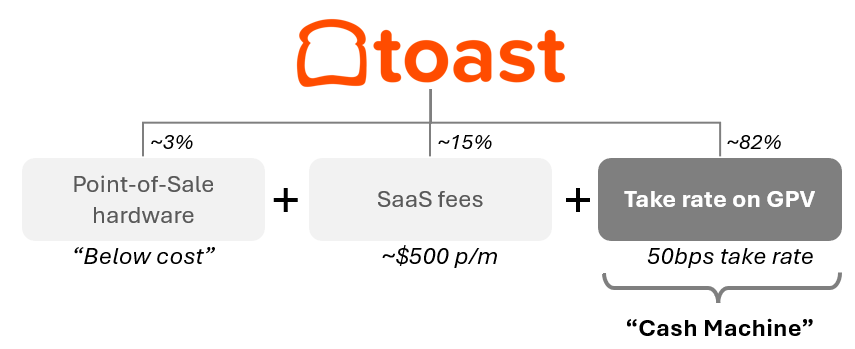
This “Shopify + Adyen” thesis rests on two pillars that, when combined, create one of the widest moats in vertical software
Source: Capital Compounding
The “Shopify” layer: mission-critical OS
Much like Shopify does for retail, Toast empowers restaurant owners to manage their entire business from a single, unified platform. It manages the front of house (ordering, table management), the back of house (kitchen display systems, inventory), and the back office (payroll, scheduling, team management).
Toast replicates this playbook through its Partner Ecosystem, allowing restaurants to plug in niche tools—from reservations to delivery—while keeping Toast as the operational backbone.
This creates “Shopify-like” retention. Once a restaurant trains its staff, builds its menu, and runs its payroll on Toast, the switching costs become astronomically high.
The “Adyen” layer: fintech fuel
Unlike traditional SaaS companies that rely solely on subscription fees, Toast (like Adyen) monetizes the transaction volume (GPV). Every burger, beer, and side of fries swiped through a Toast terminal generates high margin fintech revenue.
Adyen’s strength is its ability to offer seamless, global financial infrastructure. Toast has brought this vertically to restaurants. By controlling the payment flow, Toast has visibility into a restaurant’s real-time cash health, allowing it to offer “Toast Capital” (lending) with underwriting advantages that a traditional bank—or even a horizontal player like Square—cannot match.
The Synthesis: Vertical Fintech 2.0
The “Toast = Adyen + Shopify” thesis suggests that Toast is building the ultimate Vertical Fintech Platform.
Better than Adyen alone: Because it owns the software (the “Shopify” layer), Toast typically enjoys lower churn and higher engagement than a pure payment processor.
Better than Shopify alone: Because it owns the physical payment terminal and the card processing (the “Adyen” layer) natively, Toast captures a higher take rate on every dollar of GMV than a pure e-commerce software player.
In this deep dive, we will explore whether Toast can sustain this dual advantage as it scales, or if the gravity of hardware costs and a saturating US restaurant market will weigh down its multiple
Table of contents
Introduction to Toast
The product / market fit
The grind phase (2013-2016)
Hyper scaling phase (2017-2019)
Near death experience (2020)
IPO (2021)
Business model
The Land and Expand Strategy
The Toast Flywheel
Competitive landscape
Total Addressable Market (TAM)
The Battleground: Segmentation Strategy
Competitive Comparison
The Legacy Incumbents (The “Donors”)
Market Share Shift: Locations vs. Volume
Core moat: “The restaurant operating system”
Potential runway
Core market: US SMB Restaurants
New geographies and new verticals
Enterprise segment
Toast Capital
The $10bn ARR goal
Management
Quality Assessment of Management
Key Risks & Negatives
Note on Leadership History
Financials and valuation
Valuation: is Toast currently a bargain?
Financial model
Risks and conclusions
Introduction
Toast was founded in ’11 by Aman Narang, Steve Fredette and Jonathan Grim. All three were early employees of Endeca, a data management and e-commerce software company that was acquired by Oracle. All three were engineers which understood how to structure unstructured data very well.
The product / market fit (2011 – 2013)
After the Oracle acquisition, the founders wanted to start a company but weren’t sure what to build. The founding legend is that they were dining out and became frustrated by how long it took to pay the check.
Initially, they built a consumer app to let diners pay from their phones. It failed because restaurants didn’t want another app that couldn’t communicate with their existing cash registers.
“Despite their previous unwillingness to talk about a mobile payments app, restaurant owners would spend hours talking to us about how much they hated their existing POS system…We learned that restaurant POS systems were difficult to operate and poorly serviced. We also learned that software updates were complicated and time consuming and required service to be interrupted to perform a system reboot. Plus, if there was an issue with the update, the restaurant would have to pay a hefty fee to bring an IT person on-site to fix the issue.” (Steve Fredette, Co-founder)
They realized the existing Point-of-Sale (POS) systems were “dinosaurs”—expensive on-premises servers that couldn’t handle cloud integrations. They pivoted to building the entire operating system (hardware + software) for the restaurant.
The grind phase (2013 – 2016)
Once they pivoted to the “Full OS” concept in 2013, they didn’t just launch a website and wait for sign-ups. They realized that restaurant owners were too busy cooking to browse software websites.
Early in the build process, they realized iPads were ill-suited for commercial kitchens. They overheat near ovens, shatter when dropped, and lack ethernet ports (crucial for internet reliability). Consequently, they made the contrarian choice to build on Android. Android allowed them to develop custom, industrial-grade hardware that was “spill-proof, grease-proof, and heat-proof.”
Toast then hired a large team of local sales reps—often former bartenders or restaurant managers—and deployed them to specific zip codes. Reps literally knocked on restaurant doors to sell. Once they sold at least one unit in an area, the “flywheel” effect kicked in. A restaurant owner would see the Toast terminal at a neighbour’s venue and ask about it. The product effectively sold itself from there, allowing the rep to close the neighbour easily. Toast didn’t grow “nationally” all at once; they grew neighbourhood by neighbourhood, creating deep density in their target cities.
Hyper-scaling (2017 – 2019)
By 2017, the “feet on the street” strategy was working so well that Toast began to raise massive capital to scale the business into more cities:
July ’18: Raised $115m at a $1.4bn valuation.
April ’19: Raised $250m at a $2.7bn valuation.
They used this cash to hire thousands of salespeople and engineers. They weren’t just building a POS anymore; they were building a “Platform” (payroll, inventory, marketing). In 2018 alone, revenue grew by 148%.
Near death experience (2020)
In February 2020, Toast raised $400m at a $4.9bn valuation, leaving them well-capitalized. Three weeks later, the world shut down. Restaurant revenue across the US dropped by ~80% overnight. Since Toast’s model relied heavily on transaction volume, their revenue evaporated, forcing them to lay off nearly 50% of their workforce in a single day.
With dining rooms closed, the Toast engineering team built “Toast Order & Pay”—a QR code ordering system for takeout and delivery—in just a couple of weeks. It not only saved the company; it transformed Toast from a “Point-of-Sale” (hardware) company into a “Digital Ordering” (software) company.
Because Toast had built the restaurant operating system in-house on Android, they adapted quickly to the crisis. Online and QR ordering was easy for owners because it connected directly to the kitchen display screens—no re-typing, no errors. Furthermore, while third-party delivery apps charged 20–30% commissions, Toast charged a flat SaaS fee or standard processing rates. For restaurants struggling to survive on takeout margins, this was the difference between life and death.
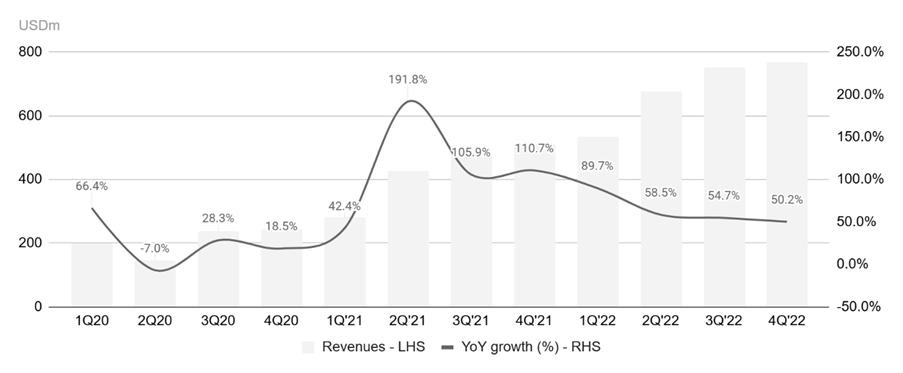
An added benefit emerged when restaurants reopened in late 2020 and 2021. Facing severe labour shortages, owners used Toast Order & Pay to allow one server to manage 10 tables instead of 4, as guests handled the order entry. By the end of 2020, Toast’s revenue hadn’t just recovered; it was growing faster than pre-COVID levels, as the graph below shows.
Source: Capital Compounding, company reports
IPO (2021)
On September 22, 2021, Toast went public during a peak of market euphoria, offering shares at $40 and valuing the company at roughly $20bn. It was one of the largest IPOs of the year. The market valued them as a pure software player (SaaS), largely ignoring hardware risks due to their explosive growth.
However, investors who bought at the IPO price of $40 and held to this date have not seen significant returns. Roughly four years post-IPO, the share price hovers around $35 to $37, still below the offering price. Meanwhile, sales on an LTM (Last Twelve Months) basis over the same period have grown with a CAGR of ~42%, highlighting a disconnect between business performance and stock performance.
In the period ’23 – ’24 Toast pivoted from hypergrowth into more durable profitable growth. One of the co-founders, Aman Narang, took back the CEO helm and the company went back to founder mode.
The remainder of this research piece is exclusive to paid subscribers.
For a small monthly fee, you can unlock full access to our entire library of Deep Dives (including detailed financial models) and receive a new, comprehensive research report every month, along with regular updates. Since May ’25, we have covered:
Your support directly fuels this platform. Every dollar is reinvested into better resources and data, allowing us to produce even higher-quality research for you.
Business model
Toast’s business model is best described as a vertically integrated, cloud-based platform that combines software, financial technology, and hardware specifically built for the restaurant industry. Management refers to the company as the “Restaurant Operating System,” connecting front-of-house and back-of-house operations across various service models (dine-in, takeout, delivery, catering, and retail).
As mentioned in the introduction, ~82% of revenue is derived from financial technology (payments). Although the market often views Toast as a SaaS (software) company, its business model is still primarily dependent on transaction volume. Toast keeps a small net take rate (approximately 55 basis points or 0.55%) on Gross Payment Volume (GPV) after paying interchange fees to banks.
This model aligns Toast’s incentives with its customers: when restaurants sell more, Toast generates more revenue. This creates a “win-win” scenario where the company is highly motivated to ensure its customers thrive—a quality we value in potential holdings.
The Land and Expand Strategy
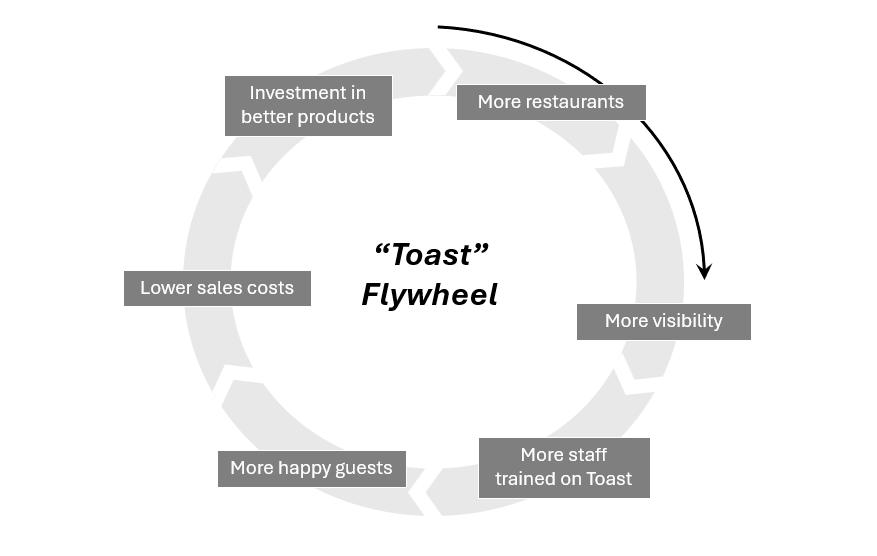
Toast operates a “land and expand” strategy fuelled by its local flywheel. The company grows city by city, using a highly effective playbook.
It starts by hiring local sales reps to walk door-to-door. Restaurant owners are typically sceptical of new technology, making the first few sales in a new city the hardest to win. This initial phase is expensive and slow. To lower friction, hardware is often sold at or near cost, with monetization starting only when payment volume begins to flow.
Once sales reps win a few foundational restaurants, the hardware begins to act as a marketing billboard. Toast terminals are distinct and sleek; when other restaurant owners visit these spots, they see the system working effectively in a live environment. Cold calls soon turn into warm leads.
The high turnover in the restaurant industry further accelerates this effect. Waiters, bartenders, and managers switch jobs constantly. If they used Toast at a previous job, they often become internal advocates when they move to a new location running on a legacy system.
As density grows, millions of local diners interact with Toast. Since Toast handles the payments (annualized GPV is currently ~$200 billion+), it captures valuable data from end customers, increasing the value proposition for new restaurants joining the platform. Higher density leads to better product fit, as explained by a former executive:
When a sales rep goes into the restaurant, they quickly assess it and say, for example, “Okay, this is a quick service taco shop”, they have DoorDash drivers coming in frequently, so they do a lot of third-party delivery, takeout, and delivery. They also have guests who need to see their orders as they’re being processed, requiring a guest-facing display. They will assess what they do and what they need and seek to understand their current technology issues and aspirations, like whether they hope to open more locations or consolidate to save money, which is crucial. They then propose a package tailored to their needs, similar to cable bundles. For example, a high-volume takeout delivery bundle might include third-party integrations, online ordering, and a self-service kiosk. (Former VP of Product, Toast, ’25)
The Toast Flywheel
This process repeats in every new city or community until there is enough scale and density to produce a profit.
“Their go-to-market motion, which is local in presence and builds relationships within communities, is part of Toast’s early success that they continue to replicate in new markets.” (Former VP of Product, Toast, 2025)
Note: In some mature cities, Toast holds more than 30% market share, while in others, they are still fighting for a foothold.
Flywheel Markets (>30% share): Boston, Austin, San Francisco, New York City, Chicago. In these cities, Toast is effectively the default choice.
Emerging Markets (<10% share): Rural Midwest, parts of California, and Miami.
For investors, this disparity is a positive signal. It proves that Toast has not yet hit a national ceiling. In theory, if they can drive penetration in the rest of the US to match levels seen in Boston, they could double their revenue without entering a single new country.
Source: Capital Compounding
Once a city is in flywheel status, it is very hard for new entrants to compete with Toast:
“…Back to this flywheel, just to remind everyone, as you get more markets in flywheel, you see better top of funnel, you see better conversion, better productivity.” (Aman Narang, Co-founder/CEO, Toast, Goldman Sachs Communicopia + Technology ’25)
The competitive landscape
Toast is a vertical market software company focused primarily on the SMB segment and, increasingly, the Enterprise segment in the US. Recently, the company has expanded into international markets, including Canada, the UK, and Ireland.
In its core US market, there is no single direct equivalent. The competitive field is fragmented, with the closest challengers being Lightspeed Commerce, Square (Block), and Clover (Fiserv). We will discuss each in detail in the following chapters, but first, an overview of the market dynamics.
Total Addressable Market (TAM)
Understanding Toast’s market share depends entirely on which denominator (TAM definition) you use. We view the market through three distinct lenses:
The “Management” View (Expansion TAM) By including new verticals (Retail) and international expansion, management defines their TAM as 1.4 million locations, placing their current penetration at roughly 10%.
“Weʼre deepening our penetration... gaining momentum across all our verticals... At only 10% share of our 1.4 million location TAM.” (Elena Gomez, CFO, Toast)
The “Broad” View (NRA Definition) The National Restaurant Association (NRA) estimates there are more than 1 million food service outlets in the US. Based on Toast’s current footprint of ~156,000 locations, this implies a market share of ~15%.
“Despite our strong growth, at just 15% market share in the US restaurant market we have tremendous headroom to scale.” (Aman Narang, CEO/Co-Founder, Toast)
The “Battleground” View (Core SMB Opportunity) We believe the most realistic TAM excludes institutional dining (e.g., school cafeterias) and the massive “Enterprise” segment (e.g., McDonald’s, Starbucks) which Toast is only just beginning to penetrate.
Serviceable Market: ~875,000 commercial restaurants (Bureau of Labor Statistics).
Less Enterprise: Subtracting ~175,000 large chain locations.
Equals The Battleground: ~700,000 SMB/Mid-market locations.
In this specific “Battleground” segment—where Toast, Square, and Clover fight for dominance—we estimate Toast’s market share is significantly higher, at approximately ~20%. Co-founder and CEO Aman Narang however sees the US SMB restaurant TAM around ~600k:
“Yeah. I think within the U.S. in the SMB, because it’s a constrained TAM, there’s always questions about, you know, TAM saturation in our business just because it’s a very specific TAM that we go after. If you look at the U.S. SMB and mid-market business, we think it’s about 600,000 restaurants. I think our penetration today is in the high teens.” (Aman Narang, Co-founder/CEO, Toast, Goldman Sachs Communicopia + Technology ’25)
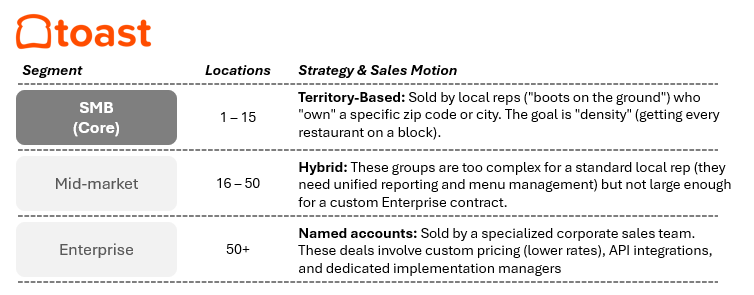
Below, we summarized how Toast approaches the market:
Source: Capital Compounding
Finally, Toast’s success stems from dissecting this TAM rather than treating it as an undifferentiated whole, which makes their approach unique and highly successful:
…whereas Toast started with SMB, specifically full-service restaurants. In the early days, they dissected the TAM. If you believe 875,000 restaurants is the TAM, they looked at each subsegment to understand the opportunity in terms of TAM, payments, ARPU, etc. This was important because each restaurant subsegment needs a different product. What a cafe, bakery, or quick-service restaurant needs is quite different from what a fine dining restaurant needs. From the outside looking in, people might not realize that. I talk to many investors who think these all look the same, like SkyTab, Square, and Toast. However, the depth of features and functionality for each subsegment is very differentiated among those platforms. (Former VP of Product, Toast, ’25)
Competitive Comparison
We can conclude that Toast has a dominant foothold in the SMB full-service market. Their vertical focus on restaurants makes their value proposition difficult for generalist competitors to displace.
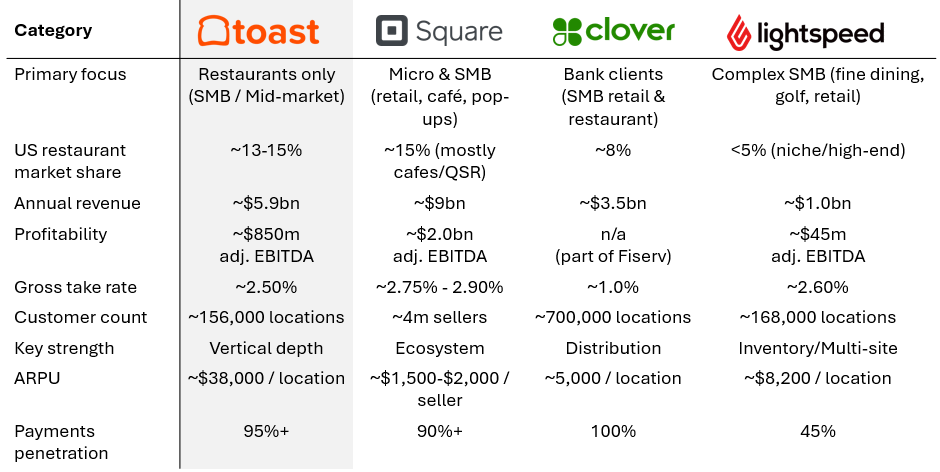
The table below compares the main restaurant technology providers based on late 2024 and projected 2025 financial data.
Source: Capital Compounding
As shown above, Toast’s revenue is of the highest quality (i.e., highest ARPU).
Square: Has more “customers,” but they are largely micro-merchants who process low volumes and have high churn rates.
Clover: Primarily distributed through bank partnerships (e.g., Bank of America), effectively capturing the general SMB market. While they have significant volume, their solution is often less specialized for complex full-service restaurant needs compared to Toast.
Lightspeed: Targets high-end venues, but because only ~45% of their clients use Lightspeed Payments, their ARPU is significantly lower than Toast’s.
Toast: Combines high volume with high payments penetration, resulting in superior unit economics.
The Legacy Incumbents (The “Donors”)
Legacy players are the companies that dominated the industry for decades before the cloud era began. Examples include Micros (Oracle) and Aloha (NCR/Voyix).
While Toast is winning the “ground war” for new independent restaurants, these legacy players still hold a massive portion of the total market, particularly among the world’s largest restaurant chains. However, Toast is slowly converting these locations, often aided by the legacy providers’ technological stagnation.
…Especially when enterprise brands face issues, like a few years ago when Aloha had a cyber attack. Toast’s phone lines exploded overnight with people wanting to switch. Could PAR Brink be ready for such situations by offering a fast, amazing onboarding process that’s entirely automated and built specifically for enterprises, which no one else has? (Former VP of Product, Toast, ’25)
Market Share Shift: Locations vs. Volume
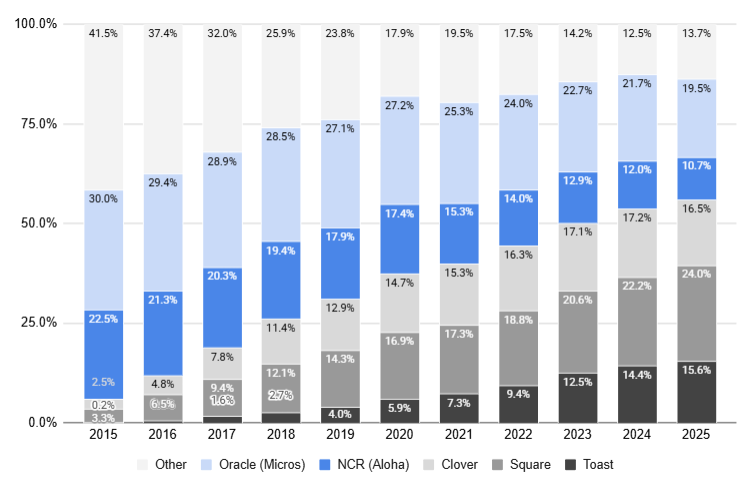
Before 2015, the two legacy giants (NCR Aloha and Oracle Micros) held a combined market share of roughly 60%. Today, that dominance has significantly eroded. In the graph below, we have plotted the shift in market share. Note that “other” also include some legacy players.
Source: Capital Compounding
In the SMB segment today, for every 10 new restaurants that open in the US:
4 choose Toast
3 choose Square/Clover
2 choose Niche Players (e.g., Lightspeed)
<1 chooses a Legacy Player (usually only if mandated by a franchise).
However, a distinction must be made between Location Share and Volume Share. If we analyse the market based on transacted volume (GMV), the 2025 landscape looks different:
Legacy Players: 60–65% (Due to “Whale” clients like McDonald’s).
Toast: 15–17%
Clover: ~7%
Square: ~5%
Lightspeed: 3–4%
While Square may have a high “location” count, nearly half are micro-vendors (coffee carts, farmers markets) that legacy players would never sell to anyway. Toast sits in the “sweet spot”—capturing high-volume independent restaurants that are migrating away from legacy systems.
Core moat: “The restaurant operating system”
Unlike Square or Clover, which started as general payment processors and added restaurant features later, Toast was built specifically for restaurant workflows (e.g., splitting checks, kitchen screens, inventory). It doesn’t just handle the payment; it runs the entire nervous system of the restaurant.
This specificity creates high switching costs. Staff develop muscle memory for the interface, and the restaurant becomes dependent on the historical data locked within the system.
“Toast started with higher complexity restaurants, full-service ones where you need to manage tables, reservations, waitlists, and have coursing in the back of the house... This allowed them to deeply understand one segment and succeed before moving onto others. That playbook is something they’ve replicated well... They started with a good foundation and a platform that’s extensible with APIs... A core product that people love, will recommend, is reliable, has good uptime, and good support—all these background elements are very important. Their go-to-market motion, which is local in presence and builds relationships within communities, is part of Toast’s early success that they continue to replicate in new markets.” (Former VP of Product, Toast, 2025)
Each time a new city achieves “flywheel” status, Toast’s moat widens. There remains ample runway, as many major US cities have yet to reach this saturation point.
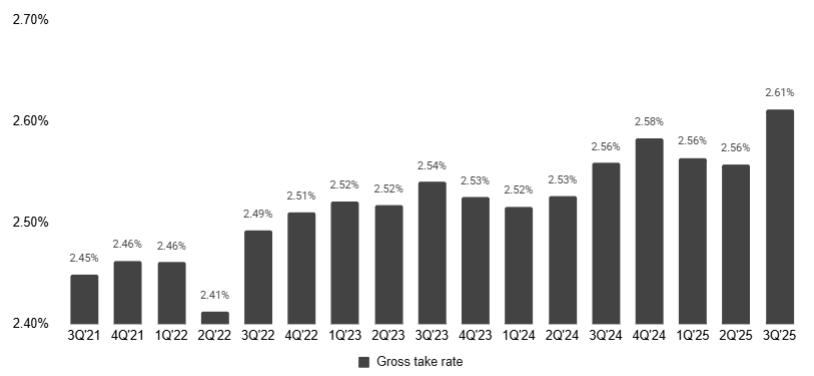
Financial metrics confirm this trend. Toast is successfully selling more modules to existing customers, and the gross transaction take rate is steadily climbing. While a rising take rate can indicate pricing power (an expanding moat), it must be validated by customer retention.
To confirm the moat is genuinely widening, we focus on three qualitative and quantitative signals:
Module Penetration: Are customers using more of the 24+ available modules? (Higher adoption = deeper lock-in).
Flywheel Density: Is the number of cities reaching >30% market share growing?
Market Share: Is the total footprint expanding despite aggressive competition?
Source: Capital Compounding, company reports
Potential runway
Toast has grown at a CAGR of ~42% since its listing in Q3 2021. Currently trading at a premium valuation of ~37x P/FCF, the stock remains an attractive investment if the company can sustain ~40% growth over the next five years. However, we believe a deceleration is likely as Toast transitions from a “hypergrowth” phase into a period of durable growth and profitability.
Despite this maturation, Toast delivered 25% year-over-year revenue growth in the last quarter. Regarding the runway for the next decade, Co-founder and CEO Aman Narang stated during the Q3 2025 call:
We surpassed $2 billion in ARR for the first time, and while I am proud of this milestone, Iʼm even more energized about where weʼre headed. We are an industry leader in the U.S. in our core business with a clear path to doubling our market share as we scale locations and deliver customer-focused innovation for restaurants. This success enables us to invest in our fast-growing new market segments. We will continue to expand our TAM into new verticals, new geographies, while increasing the capabilities we provide to our existing customers. This growth mindset is key to building a durable growth company that can scale to $5bn and $10bn in ARR and beyond. (Aman Narang, Co-founder/CEO, Toast)
Note: Toast defines ARR (Annualized Recurring Run-Rate) as the sum of subscription revenue and annualized payments gross profit.
Management expects to grow revenue by ~20% annually over the coming years. To judge the feasibility of reaching the $10 billion ARR milestone (implied 5-year CAGR of ~20% or 10-year CAGR of ~17.5%), we must dissect where this growth will come from.
Core market: US SMB Restaurants
Toast has achieved “Flywheel Density” (>30% market share) in major hubs including Chicago, Austin, San Francisco, New York City, and Boston.
However, in cities like Nashville, Milwaukee, Denver, Los Angeles, San Diego, and Miami, penetration sits between 5–10%. If Toast can bring penetration rates in these Tier-2 cities to parity with their flywheel markets (Boston/Austin), revenue from the US core market alone could double. We view this as a highly feasible baseline driver.
New geographies and new verticals
Toast expanded into the UK, Ireland, and Canada in 2022/2023, and recently entered Australia in 2025. According to recent statements, the company has added over 10,000 new locations outside the US, though this figure likely includes a mix of verticals.
Toast is also expanding into “Food & Beverage Retail,” targeting sub-sectors such as grocery stores, convenience stores, and bottle shops. Management argues there is significant overlap between restaurant workflows and these retail environments.
“The food and beverage retail market, especially in grocery and convenience, has historically been served by legacy solutions with relatively low market share across horizontal cloud-based entrants. Our vertical approach has resonated with customers because we are going deep on the challenges these customers face, including the need for a mobile inventory tool and new service models that help make it easier and faster to manage inventory, drive speed and efficiency at checkout, and improve the guest experience.” (Aman Narang, Co-founder/CEO, Toast, FY24 results call).
The estimated TAM for this segment is 220,000 locations in the US. Toast has already secured notable wins, including Zabar’s (an iconic NYC grocery store), Kelly’s Market, and Gangnam Market.
Enterprise segment
Toast continues to move upmarket into the Enterprise segment, developing specific vertical solutions such as “Toast for Hotel Restaurants” to address the unique needs of hotel F&B operations. The company recently announced partnerships with major hospitality groups including Marriott International, Choice Hotels International, and Hilton Hotels & Resorts.
In the broader enterprise restaurant space, they have reported wins with major chains including Applebee’s, TGI Friday’s, and Potbelly.
Assuming an ARR of $2bn in ’25 and 156,000 locations, this means an ARR of $12,800 per location. The ARR in new vertical Food & Beverage Retail is already above $10,000:
“In food and beverage retail, weʼre off to a strong start and the early signals are promising. Weʼre building deeper inventory management tools, expanding integrations, and scaling our dedicated sales team. Total ARPU for Retail customers is already above $10K, a clear indication our value proposition is resonating. Food retailers like Zabarʼs in New York City are using Toast Retail to handle their large, fast-paced operation, manage over 30,000 SKUs across a 20,000-square-foot store and process more than 2,500 transactions daily. Zabars shows how Toast supports complex, high-volume retail environments.” (Aman Narang, Co-founder/CEO, Toast, 2Q25 results call).
Toast Capital
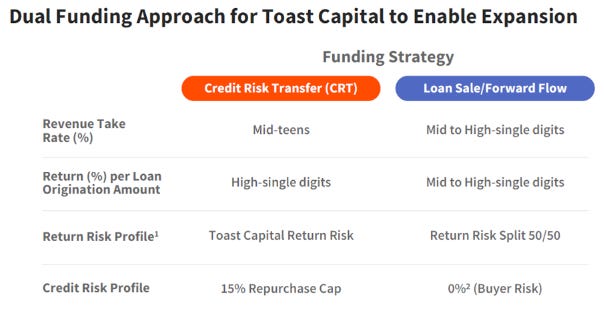
Toast Capital is a financial technology product providing eligible customers with access to working capital loans ($5k to $300k with 3–12 month terms). These loans facilitate business investment, such as renovations or hiring.
Source: Company presentation
Toast does not act as the lender itself; rather, it taps into a pool of third-party capital providers, keeping its own balance sheet light while deepening customer stickiness. Below, you can find a slide from their ’24 investor day presentation:
The $10bn ARR goal
To reach $10 billion in ARR within a decade, Toast must effectively double its location count while simultaneously doubling the ARR generated per location.
A theoretical path to $10B ARR (assuming $25k ARR per location across 400,000 locations) looks as follows:
US Core Market: Add 100,000 locations (increasing market share by ~10%).
International: Grow to 50,000 locations (UK, Canada, Ireland, Australia).
Retail/Enterprise: Secure 100,000 locations via large chains and retail shops.
Reaching 400,000 locations is physically possible given the TAM. However, the critical variable is unit economics: getting from ~$12.8k to $25k ARR per location. This relies heavily on the successful rollout and adoption of high-margin SaaS modules and financial products like Toast Capital. High quality management is key to increase the odds of successful execution; in the next chapter we will dig a bit into management.
Management
Toast is a classic founder-led company, with all three co-founders actively involved in the business.
Aman Narang (CEO & Co-Founder): The visionary behind the product roadmap. He is product-obsessed and focused on long-term innovation, specifically regarding Retail, International expansion, and AI.
Steve Fredette (President & Co-Founder): The strategist focused on market trends and future technology. He remains actively involved in daily operations—a rarity for a President role post-IPO.
Jonathan Grimm (CTO & Co-Founder): The technical architect. While less public facing, he is critical to the stability of the platform as it scales to over 150,000 locations.
Toast utilizes a dual-class share structure, a common setup in founder-led tech companies. This gives the founders (and insiders) effective control, as their combined voting power exceeds 50%, despite holding roughly ~15% of the economic shares.
While this could be viewed negatively—as public shareholders have limited say—we view it differently. In the technology sector, founder control often brings stability. It allows leadership to make difficult decisions that may be painful in the short term but beneficial in the long run (e.g., heavy R&D investment).
Quality Assessment of Management
We have identified several key indicators that highlight the high quality of Toast’s management team.
Management has proven its ability to navigate crisis. During the COVID-19 pandemic, the restaurant landscape shifted overnight from casual dining to mandatory closures and takeout-only models. Management successfully pivoted the entire company from a “Hardware POS” focus to a “Digital Ordering” software focus in just a few weeks during the 2020 lockdowns, saving the business.
Toast built its technology stack entirely in-house. Unlike legacy players, they have not engaged in “rolling up” competitors (acquiring disparate systems) to gain scale. This strategy is now paying off: having a single, unified code base makes integrating AI and complex features much easier than trying to stitch together acquired software. Growing organically is difficult and deserves a premium valuation. While Toast has acquired small companies for specific tools, the core business growth is organic.
The company is currently transitioning from “growth at all costs” to “profitable growth.” The results so far are impressive: top-line revenue is growing by more than 20% while profitability is simultaneously increasing. Typically, when a company focuses on margin expansion, growth slows down. So far, Toast has defied this trend.
Key Risks & Negatives
A primary negative has been high stock-based compensation, which exceeded 20% of revenue in the years immediately following the IPO. However, this is trending in the right direction: in 2024/2025, SBC is declining toward 10% and is expected to eventually normalize between 3–5% of revenue.
A significant point of criticism was the 2023 introduction of a $0.99 fee added directly to diner orders to boost revenue. This was implemented without the consent of restaurant owners, effectively charging the restaurants’ customers directly. It sparked a backlash from owners and allowed competitors to aggressively target Toast customers. To their credit, management rectified the error quickly, apologizing and rolling back the fee.
Note on Leadership History
From 2015 to 2023, the CEO of Toast was Chris Comparato. While not one of the original co-founders, he is widely considered a “fourth founder” due to his early entry and long tenure. Like the co-founders, Chris was an alumnus of Endeca. His leadership was instrumental in scaling the company to its IPO, paving the way for Aman Narang to take over for the next phase of growth.
Financials
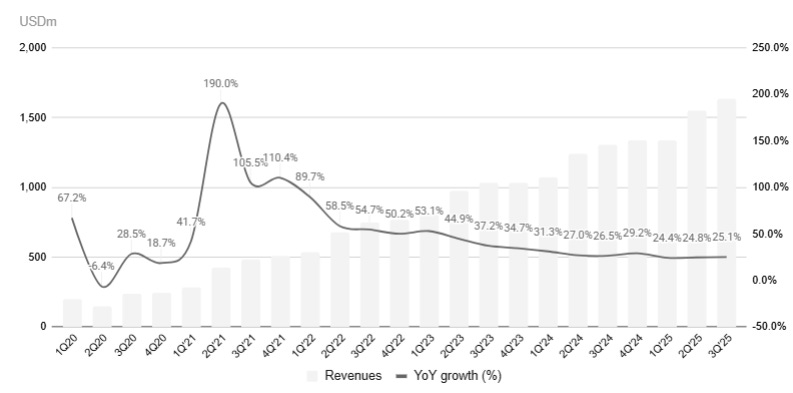
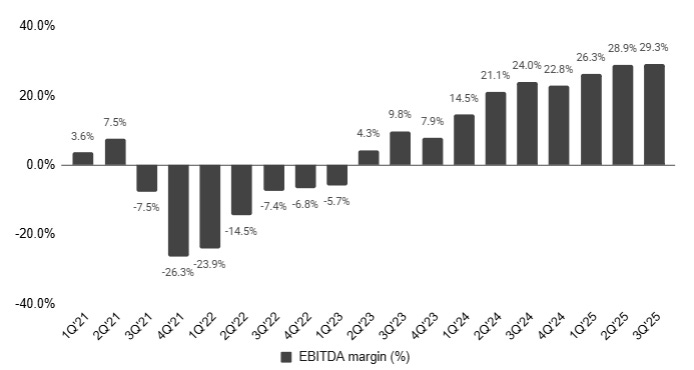
Since covid-19, revenues spiked (hypergrowth phase) and since ’23 Toast transformed towards a profitable growth phase. We plotted two graphs below that nicely highlights this.
Source: Capital Compounding, company reports
From ’23 onwards, Toast started to monetize and working on its profitability. Growth slowed down towards ~25%, but EBITDA margin hit 29% in 3Q’25. FCF margin was ~25% in the same period.
Source: Capital Compounding, company reports
As you can expect with a software company, the balance sheet is in excellent condition. No debt and small net cash position. We aluded this already in the previous sector, SBC is high, but dropping quickly and in line with management pivot towards proifitable growth (see model).
We expect Toast cannot expand margins much further and for them to continue to grow revenues ~20% as well. Management mentioned during the last call, margins to remain stable from here.
Valuation: is Toast currently a bargain?
Toast is currently trading at an LTM P/FCF multiple of ~37x. While this is not objectively cheap, it represents the company’s lowest valuation since listing.
Shareholder returns since the IPO have been negative (-11.7% CAGR), despite the company growing revenue at a CAGR of ~42% and reaching a substantial FCF margin of ~25% in the latest quarter. The stock initially listed at an excessive multiple—a common occurrence among tech IPOs in 2021—resulting in negative returns for many early investors as valuations compressed.
However, the risk-reward profile has shifted in the investor’s favor. We project that Toast can grow revenue at a ~20% CAGR over the next five years while maintaining current profitability levels (in the latest quarter alone, revenue grew by ~25%).
Scenario Analysis:
Base Case: Assuming Toast continues to grow meaningfully beyond the five-year period, we apply an exit multiple of 25x. At the current share price of $36, this yields an IRR of ~11%.
Target Entry: At a share price of $30, the IRR improves to ~15%, which we view as a more attractive entry point.
Bull Case: If Toast successfully expands its Food & Beverage Retail vertical and sustains ~20% growth beyond year five, a 28x exit multiple is justified. In this scenario, purchasing at $30 would drive the IRR toward 20%.
Financial model
A complete financial model about Toast can be found here: [link]
Risks and conclusions
If the US economy enters a severe recession, this could temporarily hurt Toast. As we have seen from our description of Toast’s business model, the majority of their revenue comes from Gross Payment Volume (GPV). While we view this alignment as a positive (incentives are aligned between the restaurant and Toast), if restaurant turnover drops, it will directly impact Toast’s revenue.
Management has downplayed the severity of this risk:
“Restaurants adapted and bounced back from unprecedented conditions during COVID and have successfully navigated prior economic downturns. It’s a testament to how much people enjoy the restaurant experience. Even in the most challenging times, people love eating out and restaurants are often at the center of our community.” (Chris Comparato, former CEO, Toast, Q2 ’22)
However, this is a risk to keep in mind. We do not consider it a fundamental threat to the business model, but since Toast is “priced for perfection,” a slight revenue slowdown could cause the stock to de-rate materially. We have seen this recently with Adyen. We would view such a drop as a buying opportunity rather than a structural failure.
TAM Saturation
could be a risk hampering growth in the long term. Currently, Toast has a very strong position in the US SMB restaurant segment. If they fail to increase their share in cities with <10% penetration, or if the rollout into new verticals proves unsuccessful, growth will be limited to existing ‘flywheel’ cities.
To track the company’s progress, we monitor:
The number of new locations being added.
The number of cities reaching “flywheel” status.
Conclusion
Toast is undoubtedly a high-quality business. It is expanding its margins while growing the top line by more than 20%. Additionally, there is significant market share left to capture from legacy players, especially internationally.
However, a great business does not automatically make a great investment. If the valuation is too high, even an extremely strong set of 5-year results may not yield a decent return. The share price performance of the last few years has shown this.
Currently, the multiple is more reasonable at ~37x P/FCF. However, to target an IRR of at least 15%, our ideal entry point is around $30 (~15% lower than the current share price). One bad quarter could easily re-rate the stock, so we will remain patient for our moment to come.
Disclaimer
The information in this article is provided for informational and educational purposes only. The information is not intended to be and does not constitute financial advice or any other advice, is general in nature, and is not specific to you. Before using this article’s information to make an investment decision, you should seek the advice of a qualified and registered securities professional and undertake your own due diligence. None of the information in this article is intended as investment advice, as an offer or solicitation of an offer to buy or sell, or as a recommendation, endorsement, or sponsorship of any security, company, or fund. The author is not responsible for any investment decision made by you. You are responsible for your own investment research and investment decisions. The author may or may not have shares of the company.