
Meta 4Q’25 results recap
From 'AI loser' to 'AI winner'

On Wednesday (January 28), Meta published its 4Q’25 results. I expected the results to be good, as key metrics like ad impressions and daily active users (DAUs) have been improving over the last few quarters. The results were indeed strong—revenues grew by roughly 24%, while ad impressions improved +18% (accelerating from +14% in 3Q and +11% in 2Q, see graph below).
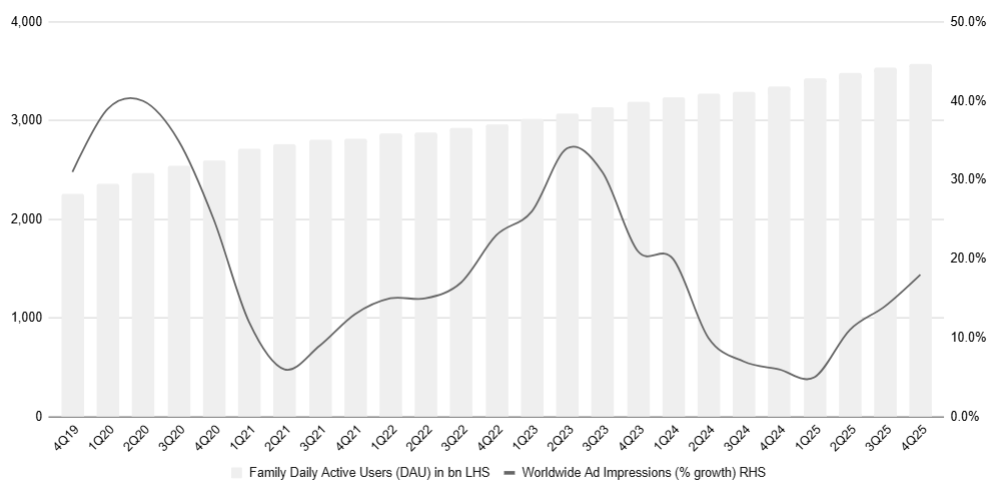
Source: company reports
Management noted that model rollouts drove a 24% increase in incremental conversions for advertisers. This is a direct proxy for ROI; better AI prediction = higher conversions = advertisers willing to pay more. Additionally, Reels watch time increased 30% YoY in the US, proving that the AI recommendation algorithms are successfully retaining attention, which in turn creates more ad inventory.
More importantly, 1Q’26 revenues are expected to accelerate to around +30%. The narrative has (again) shifted from “spending fears” to “proven returns” regarding their heavy AI capex.
The market has been extremely punitive to perceived “AI losers” (i.e. horizontal and vertical software), so it was no surprise these results were received well. The massive increase in ‘26 capex guidance ($115bn – $135bn, up from $75bn in ‘25) was largely shrugged off. Crucially, this is because Meta moved beyond vague promises and proved that Gen AI is already a massive revenue driver. Management revealed that their AI-powered creative tools have hit a $10 billion run-rate, while business messaging on WhatsApp (driven by AI agents) crossed $2 billion. Investors are no longer viewing the capex as speculative R&D, but as necessary fuel for a verified monetization engine. I am starting to belong to that camp as well.
“…Another area we’re deploying AI to improve performance is ad creative. The combined revenue run-rate of video generation tools hit $10 billion in Q4, with quarter-over-quarter growth outpacing the increase in overall ads revenue by nearly 3x… …Paid messaging within WhatsApp continues to scale as well, crossing a $2 billion annual run-rate in Q4…” (CFO, Susan Li, Meta Platforms)
It feels like this is just a glimpse of what we can expect from Meta Platforms.
A Shift in Perspective
After the euphoria of 2Q’25, I had mixed feelings. Back then, it wasn’t clear how Meta would monetize this massive infrastructure. To justify the investment, revenues needed to grow meaningfully on an already massive $180bn run-rate base.
It also wasn’t clear how much return was coming from Core AI (immediate ad targeting) versus Gen AI (future creative tools). This quarter, however, the disclosure that video generation tools hit a $10 billion run-rate finally quantified the “Gen AI” impact. These signs confirm that the investments are starting to pay off. While Mark Zuckerberg remains vague about the long-term endgame (or is playing his cards close to his chest), the new revenue streams offer comfort. They give me confirmation that Meta is not “lighting money on fire” as the market feared with the Metaverse years ago. We now just have to watch how the new product rollouts sustain this momentum.
Looking Ahead: Costs & Strategy
The investments—not only in infrastructure but also in personnel—have been weighing on the bottom line. Although revenues grew by 24%, total costs and expenses grew even faster (+40%). For this year, we can expect a similar trend where revenue growth will again outpace growth in operating income:
“…Mark, on your second question, I want to make sure and clarify something. So, I think in the question, you had said that operating income growth in ‘26 would be higher than ‘25. And I want to make sure my comments were super clear. In 2026, we expect to deliver operating income above 2025 operating income. So, this is comparing absolute dollars, not year-over-year growth. So, to give some context on that, we are going into 2026 with strong revenue growth at the start…” (CFO, Susan Li, Meta Platforms)
Management shared other key details, such as the surge in demand for their glasses, the establishment of Meta Compute (a new top-level organization Zuckerberg established to centralize and speed up the company’s massive infrastructure build-out), and the aim for “personal superintelligence.”
In the Q4 call, Zuckerberg essentially declared that Meta’s “data advantage” (knowing who your friends are and what you like) allows them to build AI that is more useful than ChatGPT because it has context. This is something that crossed my mind as well over the months. Who has the most data? Google remains the absolute winner with ~5bn daily users, but the closest second is Meta with ~3.6bn users. Amazon and Microsoft are miles behind.
I expect revenues to land around ~$250bn this year, which implies +25% YoY growth. Meta is expected to have a ~4% currency tailwind in Q1, though this is not assumed to remain favorable all year. With the increase in capex this year, I expect ’27 to become a strong year for revenue growth as well. Profits have been suppressed by infrastructure costs and expensive hiring, but at some point, I would expect that to pay off.
Before these numbers, Meta wasn’t considered an “AI winner.” Since Meta is my only investment in tech, I can now say the portfolio has some real exposure to AI.
Enjoy the rest of your Sunday!
Disclaimer
The information in this article is provided for informational and educational purposes only. The information is not intended to be and does not constitute financial advice or any other advice, is general in nature, and is not specific to you. Before using this article’s information to make an investment decision, you should seek the advice of a qualified and registered securities professional and undertake your own due diligence. None of the information in this article is intended as investment advice, as an offer or solicitation of an offer to buy or sell, or as a recommendation, endorsement, or sponsorship of any security, company, or fund. The author is not responsible for any investment decision made by you. You are responsible for your own investment research and investment decisions. The author may or may not have shares of the company
Great insights on META! Really valuable analysis.
That shift in narrative from 'spending fears' to 'proven returns' for Meta's AI capex was a fantastic insight, showing how quickly the ROI curve can steepen when the models realy click. It's almost funny how the market shrugs off huge spending when it sees that kind of bottom-line impact; turns out 'AI' wasn't just a buzzword after all, eh?