
Celsius Q3 2025 Update
Strong quarter, but shares drop 25%!?!

Celsius Q3 2025 Update
Celsius published its third-quarter results, and below you will find the key highlights:
Q3 2025 revenues were up 173% to $725 million. Year-to-date (YTD) sales are up 75%, rising from $1,023 million to $1,794 million.
GAAP EBITDA and EPS were respectively -$65.8 million and -$0.22. Adjusted for the integration with PepsiCo distribution, EBITDA would have been $205.6 million and EPS $0.42.
YTD EPS on an adjusted basis rose from $0.55 to $1.10 (+100% year-over-year).
Celsius had to book a one-time distributor termination fee of $246.7 million to move Alani Nu’s distribution from Anheuser-Busch to PepsiCo. This cost is fully funded by PepsiCo under the long-term agreement.
The brand’s market share reached 20.8% in the U.S. energy drink market.
Debt was reduced by $200 million by the end of the quarter, decreasing to $700 million. This is expected to reduce the annual interest expense by $20 million from 2026 onwards.
It was again a strong quarter yet shares dropped about 14% after the numbers were released and then another 11% after the earnings call concluded. Before diving deeper into the earnings, I want to acknowledge that big share price moves in growth companies happen. Notably we have witnessed that amongst a large group of companies around Q3 ’25 earnings (i.e. DUOL, NFLX, HOOD, DASH), we have seen significant share price volatility. Please keep in mind, investing successfully for the long term is not supposed to be easy.
That being said, it is for us to judge if this share price drop is justified and if the situation is structural or merely a temporary issue. With Celsius, I believe the issue is temporary, and the move seems highly overdone. The growth trajectory is still intact.
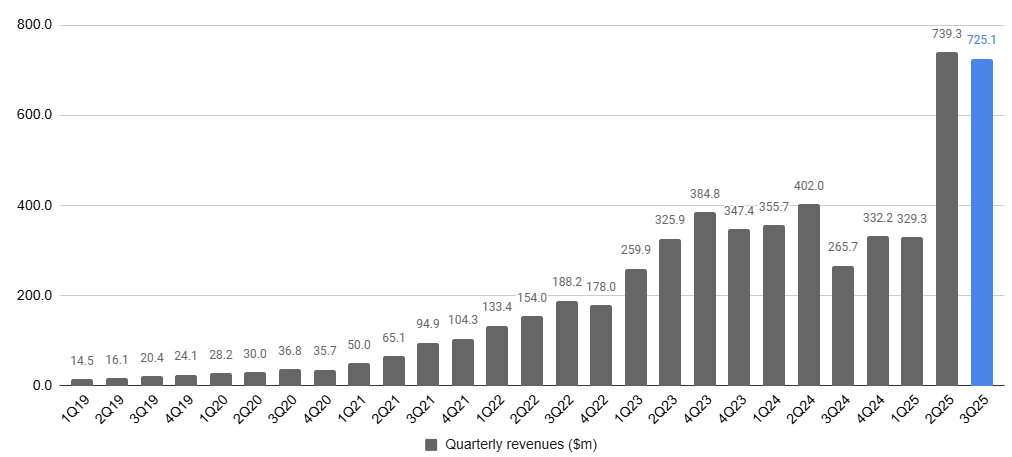
Source: company reports
We wrote earlier about Celsius; please find the latest posts below:
The Drop: Termination Fee and Q4 Caution
The main reasons for this drop are the $247 million distributor termination fee incurred on the P&L statement and management’s cautiousness on Q4 2025 results. This caution stems from the transition of Alani Nu from Anheuser-Busch distribution to PepsiCo, starting on December 1, 2025. Management mentioned the transition would be “messy.”
The CFO’s comment during the call regarding the termination fee was:
“… In connection with Alani Nu’s transition into PepsiCo’s DSD network, we recorded approximately $247 million in distributor termination expenses during the quarter. These costs are fully funded by PepsiCo under our long-term agreement, and while they are recognized in our P&L under GAAP, the reimbursements are deferred on the balance sheet and amortized into gross sales over the life of the distribution agreement, making the transactions cash-neutral to Celsius Holdings.” (CFO, Jarrod Langhans)
I view this as a one-off event. When we normalize the earnings for this termination fee, Celsius is clearly on track within its growth path. The rest of this post will be for paid subscribers.
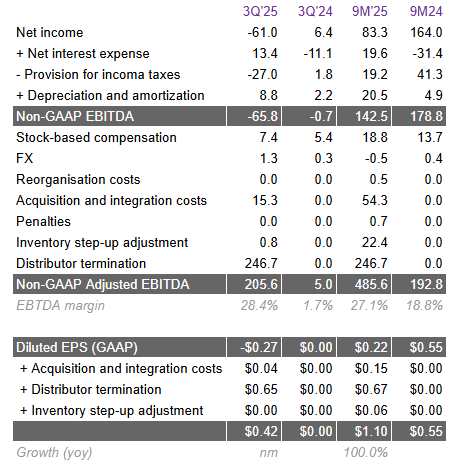
Source: company reports, CC estimates
When looking over the nine-month period and normalizing for these one-offs, Celsius grew its EPS by 100% and EBITDA by 110% (from $193 million to $486 million).
Celsius recently announced that Alani Nu would move to PepsiCo’s distribution network in the U.S. This is something we anticipated and highly applaud, as PepsiCo has a wider and broader distribution network. This move is expected to drive further sales growth and margin expansion. More details about it can be found here:

We also highlighted in that note that there is always execution risk with both acquiring Alani Nu and then moving it to PepsiCo’s network. When Celsius moved from AB InBev to PepsiCo, the transition had some hiccups, the largest issue being initial overstocking (and subsequent de-stocking) by PepsiCo.
The integration of Alani Nu thus far has been going very well, as revenues from both Celsius and Alani Nu accelerated in recent quarters, with gross margins well above 50%.
The Next Hurdle: The Q4 Transition
The next hurdle will be the transition from AB InBev to PepsiCo in Q4.
“Looking ahead, we expect continued growth in both Celsius and Alani Nu with a focus on stabilizing Rockstar Energy as we optimize the product assortment and re-establish the identity that makes that brand so relatable to consumers. We anticipate Q4 will be a noisy quarter reflecting year-end timing effects from promotions, integration activities and cash management from our largest customers along with some incremental freight and tariff pressure. We are looking at the potential for more pressure on our gross margins in Q4 2025 relative to the prior three quarters due to promotions, higher scrap and freight from the integration of Alani into the Pepsi system and tariff pressure before re-expanding in Q1 2026. We also expect sales and marketing to represent 23% to 25% of sales in Q4 as we continue investing in our Celsius Live Fit Go campaign and complete the Alani Nu transition.
…Our near-term priorities remain unchanged: Continue investing in brand growth, capture synergies from our acquisitions, and further strengthen the balance sheet through debt reduction and disciplined production, and disciplined capital allocation. As Alani begins distribution in the U.S. Pepsi system in December, most of the financial benefit is expected to be realized in Q1 2026 due to a phased load-in approach ramping from Q4 into Q1 as retailers reset and inventory builds across the Pepsi network.” (CFO, Jarrod Langhans)
Of course, everyone, including me, wants a smooth and clean transition. But the reality is that it’s often not possible, and Q4 will be a messy quarter. It will, however, result in a stronger profile in the years and decades to follow—a small price to pay when viewed in this way.
When Celsius moved to PepsiCo distribution in early October 2022, the transition was easier because PepsiCo had a gap from Bang leaving, and Celsius immediately filled it. Brands typically discuss shelf space with retailers at the beginning of the year.
This time, Alani Nu will be phased into the PepsiCo distribution in Q4 and Q1:
“Yes. So, it’s -- I mean, it’s Q4 and it’s December when the activity is happening. If you go back to when Celsius went into the Pepsi system, it was October 1st. We’re going in on December 1st. So, obviously, a lot of CPG companies -- there’s not a lot of activity at the very end of December. Also, if you recall, when we went in, we were replacing Bang. So, it was a one for one swap out. So, there was a ton of space that needed to be filled immediately. So, it was a bit quicker of a push.
So, it’s going to be more of a phased approach. And because we’re so close to kind of the timing of resets, and when the OTS, the kind of up and down the street programs are reloaded, we’re going to kind of phase it in as opposed to have all this open space that’ll get shoved into. So, I think it won’t be quite as quick as you saw back in ‘22. But across kind of December in Q1, you’ll see us really ramp up from Alani perspective, but there will be some crossover in the quarter as we build that inventory and as we roll it out across really Q1.” (CFO, Jarrod Langhans)
Summary of Q4 Headwinds
To summarize, there will be a lot of inventory movement. Former distributors will wind down their inventory and return remaining products, while the new distributor, PepsiCo, will build up Alani Nu inventory. This process may temporarily affect sales and inventory levels across all brands.
Celsius will see increased costs related to these logistical movements, such as picking up returns from the prior distribution network and costs associated with secondary warehousing. There will also be higher scrap and freight costs resulting from integrating Alani into the Pepsi system, which will temporarily weigh on gross margins.
On top of that, management will increase sales and marketing expenses to 23% to 25% of sales in Q4, which will weigh on the bottom line.
Celsius Brand Sales Growth Q3 2025
The Celsius brand within the portfolio grew sales by 44% in Q3 2025, while the U.S. scanner growth rate was only 13%. Celsius recognizes revenue upon delivery to its distributor partners and retailers, who then sell the product to the end customer (tracked by scanner data).
Over time, these two numbers should align. In the short term, a mismatch can occur due to the timing of inventory uptake by distributors. When comparing Q3 2025 revenue to the depressed revenue base of Q3 2024 (which was impacted negatively by the inventory optimization), the growth rate appears significantly higher (44%). The inventory optimization in the prior year quarter negatively impacted Q3 2024 revenue.
Below slides provided by the company gives a cleaner picture how to look at the growth of Celsius.
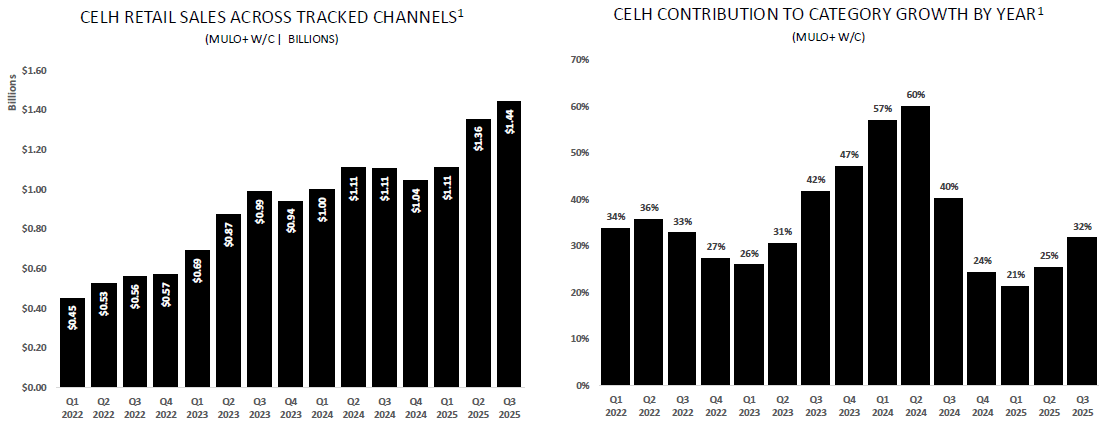
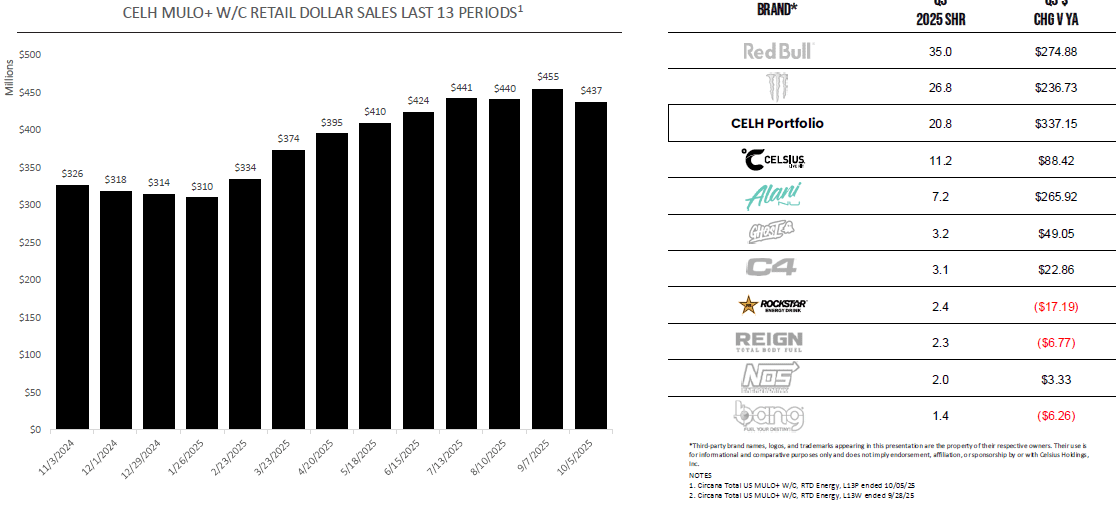
Source: company reports
Conclusion
The share price dropping 25% after doubling this year is simply part of being a growth stock. Celsius has some challenges ahead with the integration of Alani Nu into the Pepsi distribution network. Although the timing is not ideal, I have confidence in management to execute well, as they can apply learnings from the previous Celsius transition. Additionally, with the acquisition of Rockstar Energy from PepsiCo and becoming PepsiCo’s U.S. strategic energy drink captain, they will have greater control over the distribution of their leading portfolio of brands.
So a rough quarter ahead of us, but the growth trajectory remains intact. I updated the model and included last quarters numbers. At the current share price, I see an IRR of ~18.4%.
Disclaimer
The information in this article is provided for informational and educational purposes only. The information is not intended to be and does not constitute financial advice or any other advice, is general in nature, and is not specific to you. Before using this article’s information to make an investment decision, you should seek the advice of a qualified and registered securities professional and undertake your own due diligence. None of the information in this article is intended as investment advice, as an offer or solicitation of an offer to buy or sell, or as a recommendation, endorsement, or sponsorship of any security, company, or fund. The author is not responsible for any investment decision made by you. You are responsible for your own investment research and investment decisions. The author may or may not have shares of the company.
Another excellent article in which you clearly outline the fundamental dynamics of the business. The next two quarters may still be a bit bumpy, but the underlying growth remains intact, and the brands continue to offer strong potential for innovation, both across new categories (as Monster once did) and through alternative formats, such as larger can sizes.
Thanks 🙏