
Celsius Holdings (ticker: CELH)
Breaking up the monopoly held by Red Bull and Monster Energy?

Hi fellow investors!
Remon here from Capital Compounding! In the last couple of weeks, I have been very busy writing investment cases! Today, I would like to present to you our third compounder: Celsius Holdings (ticker: CELH), a US based energy drink brand differentiating itself as a healthier alternative than Monster and Red Bull.
I started following Celsius Holdings at the end of last year. It reached a high of $95 in May ‘24 and a low of $22 in Feb ‘25. At the time of writing it is trading around $40 to $41 a share. It has been a volatile ride but still down about ~60% from its peak. The question remains, is this an interesting business? What would make this a successful investment? And what could break up this thesis?
To answer these questions, we went deeper into the business model and looked at it from different angles. A lot has happened in the last 6 to 12 months. PepsiCo ordered less drinks from Celsius in the 2H24, Celsius acquired one of its producers (Big Beverages) and on top of that, it acquired its direct competitor Alani Nu!
Investment thesis
Celsius is a fast growing energy drink brand differentiating itself from Red Bull and Monster and positioned itself as the healthy alternative. It is transitioning towards stable growth where we can expect increasing margins. The energy drinks market is expected to grow by about 8% in the coming five years
Celsius has partnered up with PepsiCo who facilitates the distribution creating barriers to enter for potential new upcoming players. Since the partnership, Celsius reached a market share between 11 and 12% in the US
Celsius has recently closed a deal where it acquired its closest competitor Alani Nu. Alani Nu has seen the same explosive growth as Celsius had in the last two years and the management of Celsius has the experience to continue this growth path
Internationally, there seems to be less competition than in the US. Especially in Europe. If Celsius executes well, there is a long growth path left for them
Celsius Holdings has the characteristics of a compounder: high ROIC, growing moat, skillful management and long runway (internationally)
If you are interested to learn more about Celsius, please read further!
Small disclaimer, as a shareholder, I am biased, so take everything with a pinch of salt what I write. Nevertheless I try to be as objective as possible.
Introduction
Celsius Holdings, or Celsius, has been a fast growing energy drink brand growing its revenues from $131m in ‘20 to $1,357m in ‘24. a staggering growth (CAGR) of ~60%! Celsius has been differentiating itself as a ‘healthier’ version of Red Bull and Monster using natural ingredients, no sugar and no aspartame which appealed to a different customer group, mostly fitness enthusiasts and health-conscious people.
To be honest, having consumed about 50 cans over the last 4 to 5 months, they can be a bit addictive as well! Celsius drinks come in various flavours and you can consider it a drink for the afternoon, rather than something you drink straight away in the morning to kick start your day.
This is the consumer group mostly targeted by Monster and Red Bull. Currently, Celsius has a market share of around 11-12% in the US.
Celsius has been around for almost 20 years and was listed in ‘06 on the Nasdaq to be subsequently delisted in ‘10 due to poor sales and high costs. New management and particularly the CEO John Fieldly, who joined in ‘12 brought new life into the struggling energy brand.
The product itself to my knowledge hasn’t changed at all. It was all about repositioning the brand, where it initially looked from something you would rather expect at a pharmacy, to a drink that looks so appealing that you just want to give it a try. I think a picture gives you a sense what I mean:
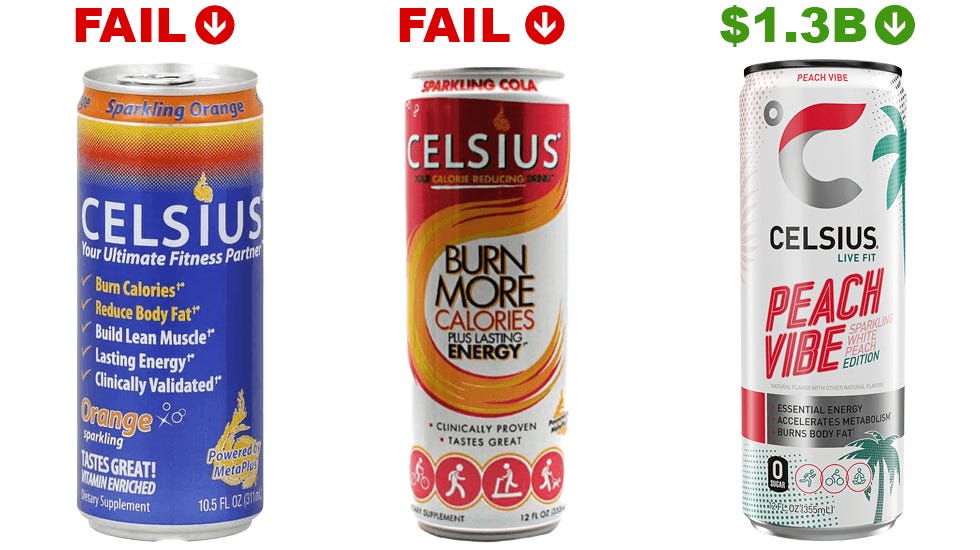
At the helm of John Fieldly, Celsius underwent a massive re-branding. It wasn’t just about the new packaging, it was about redefining Celsius’ position in the highly competitive energy drink landscape. And it worked, over the years Celsius managed to carve out a unique space in the energy drink market dominated by Monster and Red Bull. According to a former Commercial Director from Monster Energy:
For some, early in the morning, energy drinks are their coffee. They're not drinking a grande Starbucks; they're picking up a 16-ounce, 20-ounce, or even 24-ounce energy drink to kickstart their day. When I was at Coke, we analyzed that women wanted an afternoon occasion, especially moms needing energy for after-school sports or school pickup. There was a stigma with holding a Red Bull or Monster, which didn't fit with the female consumer. Celsius has changed that with their flavors, brand positioning, and sweeteners.
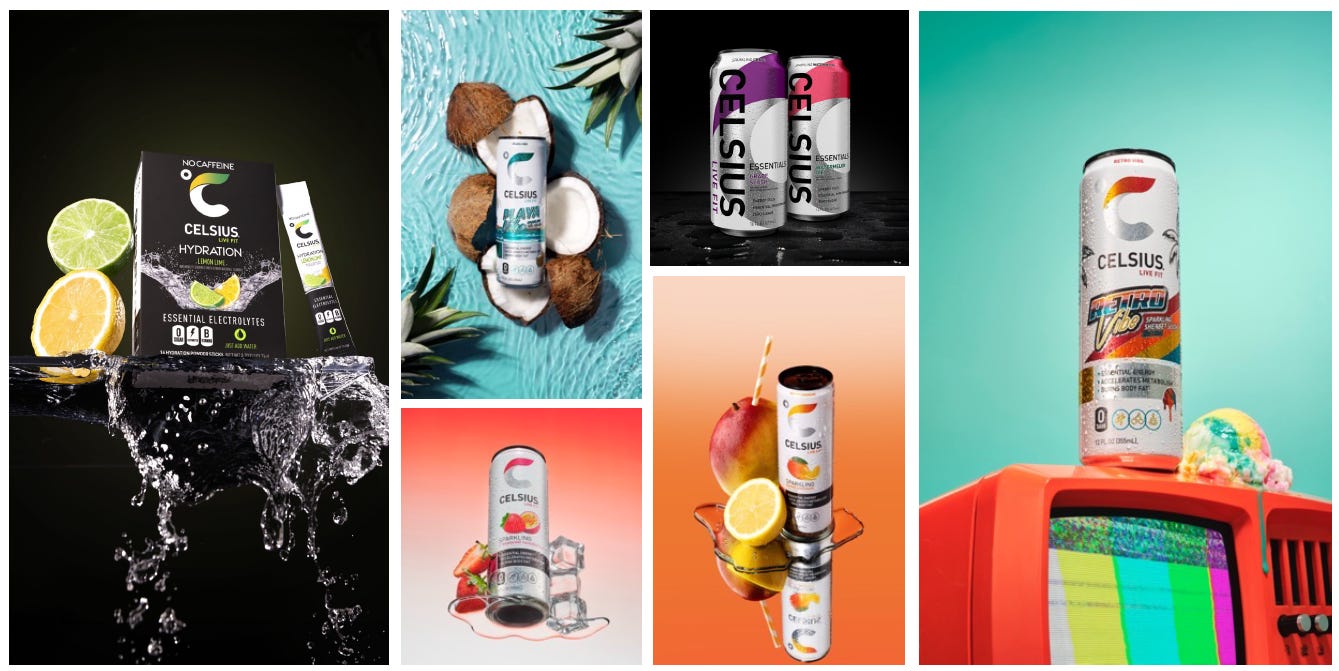
About 50% of their consumers are female. Nowadays, Celsius has various flavours and they keep innovating with new products, with hydration sticks as the last example.
Distribution
To have an appealing drink that resonates with your customers doesn’t bring you to an established brand. Distribution is a critical part of your success and to build that up from scratch is nearly impossible (although Red Bull managed to do it successfully two decades ago). By distribution, I mean to be able to bring your products from your warehouse to every retail outlet imaginable, from supermarkets and convenience stores to restaurants and vending machines. So the top three beverage distributors in the US are:
The Coca Cola Company
PepsiCo
Keurig Dr Pepper
Monster Energy drinks have been distributed by Coca Cola since ‘09. This partnership significantly deepened in ‘14 when Coca Cola and Monster Beverage announced a long-term partnership. A significant cash payment was made by Coca Cola and it brought some of its energy drink brands (i.e. Burn, Full Throttle and Relentless) under Monster. In return, Coca Cola received a stake of 16.7% from newly issued shares by Monster. Since then, Monster have remained consistently a #2 player behind Red Bull with a market share ranging from 20-30%.
In ‘18 Celsius announced distribution agreements with Anheuser-Busch (AB Inbev) and PepsiCo. Anheuser-Busch is a large distributor as well but lacks the scale of PepsiCo due to its focus on alcoholic beverages. In August ‘22, Celsius then transitioned its primary US distribution to PepsiCo, with a long-term strategic distribution agreement similar to Coca Cola and Monster did back then in ‘14. Details were discussed during a call:
As a review over the transaction, Celsius and PepsiCo have entered into a long distribution agreement an associated investment, PepsiCo has become Celsius preferred distributor in the United States with future expansion opportunities as our preferred global distribution partner, Celsius enhances PepsiCo's existing energy drink portfolio and the attractive healthy lifestyle energy category And PepsiCo will assist with the costs associated with the transitioning of the existing Celsius distribution agreements. In parallel, With a $550,000,000 convertible preferred stock investment made by PepsiCo in Celsius and the investment aligns incentives for both parties And the shares underlying the investment were priced at $75 per share or approximately 7,300,000 shares when which equates to an 8.5% ownership in Celsius on an as converted basis. The preferred shares receive a 5% annual dividend paid quarterly in cash or in kind at Celsius' option, primarily proceeds will be used to fund growth initiatives, capital investments and operating expenses. (John Fieldly, CEO, Celsius)
So PepsiCo made an investment of $550m in the form of convertible preferred stock which equates to ~8.5% ownership. A small caveat in this deal is that Celsius will have to pay a 5% annual dividend quarterly in cash or at Celsius’ option, paid-in-kind (PIK). Basically it can choose to pay PepsiCo in cash or issue more preferred stock if they don’t wish to pay in cash. Since the deal has been closed, Celsius has been paying the dividends in cash. On August ‘28, the preferred shares will convert to common shares. According to management, PepsiCo acquired shares for $75. The rationale for Celsius to enter this transaction according to management is:
Partnering with PepsiCo is a transformational opportunity to gain immediate scale and accelerate market share by securing access to a leading North American DST network with global reach. The agreement provides material expansion across new and existing channels with the addition of significant incremental doors, coolers and ACV upside. In addition, we have significant opportunities to streamline our supply chain with aligned incentives and added focus. (Jarrod Langhans, CFO Celsius)
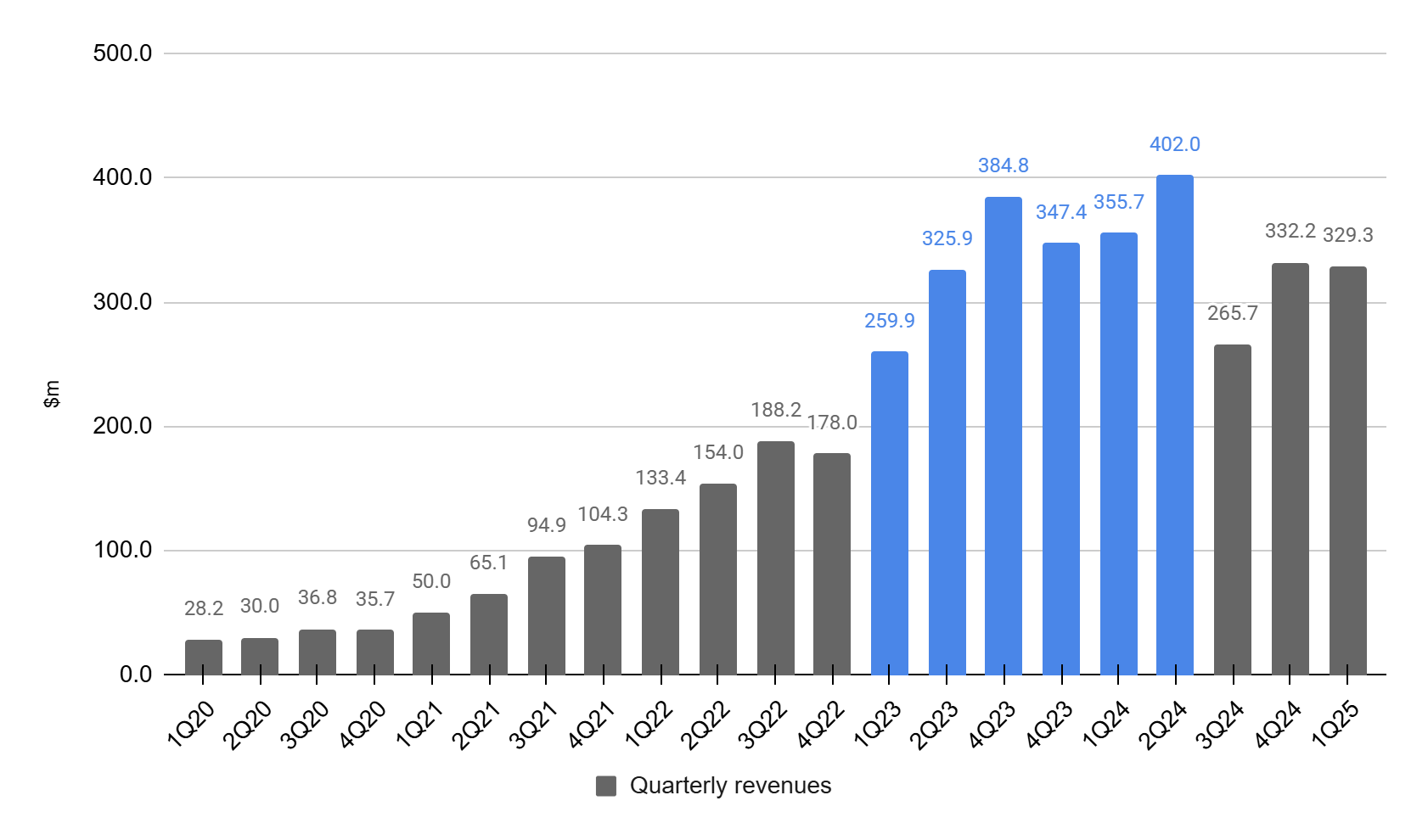
A win-win transaction which cemented Celsius’ presence in the energy beverage market as the #3 player and giving PepsiCo a healthier product in their beverage category. One important fact to mention is that PepsiCo is the customer and buys the drinks from Celsius and then sells to its retailers. So there is a small time lag when Celsius reports revenues and the customer actually buys the product.
And right after the transaction, it seemed that PepsiCo bought a lot from Celsius, probably a bit too much at the end ‘22 (blue bars) resulting in less buying from PepsiCo until they sold their own inventory, or destocking. This resulted in the (although highly overvalued) share price crater.
Shelf space
Shelf space is critically important for energy drink brands like Celsius. Think of factors like visibility and impulse buying, brand dominance and recognition, competitive advantage as a brand. The more you sell, the more shelf space you get. But it is a bit of a chicken and egg story here. If you have little shelf space, you will most likely sell less. The more shelf space you have, the higher the chance a brand sells. Monster and Red Bull are the established players and naturally have more shelf space.
Because Celsius's market share is growing, at year end or quarter end, new allocations are negotiated with retailers. It helps that PepsiCo is the distributor for Celsius as they have more leverage than Celsius would have on their own. This is what the CEO had to say about it in Q1 ‘24
…We estimate that retailers' spring resets were approximately 1/3 complete at the end of the quarter. And once concluded, we're expecting our best shelf space gains in the company history. The importance of these space gain increases and placements and improvements cannot be overstated. The visual impact of multiple full shelves of cold Celsius in convenience stores and coolers and in the grocery shelf is a powerful in-store billboard and showcases our portfolio. The full effect of these shelf resets is expected to be reflected in the scanner data beginning in July…
In Q1 ‘25, management again mentioned that they will see incremental gains in shelf space:
As we look forward the second and third quarters this year, we expect to continue gaining incremental space at retail, helping to drive greater consumer awareness and flavor availability, including recent innovation like CELSIUS Playa Vibe, Retro Vibe, Mango Lemonade. According to Circana, our average items selling per store within the Celsius brand family increased by 4.1 items in MULO Plus with Convenience during the first quarter. With even greater gains in the food and chain convenience channels, underscoring the continued expansion of our in-store presence.
This year's gains are particularly meaningful because they lap the strongest shelf reset cycle in our company's history, which were reported during our Q1 2024 earnings call. Dollar sales for sugar-free energy drinks surpassed full sugar varieties for the first time in 2024.
Currently, Celsius has a market share of 20% on Amazon, which is quite interesting. It tells us, if the level playing field was equal, i.e. shelf space, distribution etc then Celsius should be able to have a much higher market share than the 11-12% it currently has. The lies within the convenience space where Celsius is relatively new. The bull case would be then, eventually they will grow into more shelf space and hence potential increase in market share. But the best distribution they will not have.

But the real indication, how well Celsius doing is, is via the scanner data, which means when the items are actually sold to customers. This part will be discussed in the competition section in more detail.
International
Majority of the revenues (~93%) is coming from the US, but Celsius is slowly expanding in Europe.

Via Suntory Beverage & Food as a key distributor, Celsius is starting to sell in Belgium, Netherlands, UK, France. I wondered why they chose Suntory instead of PepsiCo. By doing some research, I realized that in key countries PepsiCo (like the UK) doesn’t distribute directly to retailers. They have partnerships with local distributors. Suntory Beverage & Food Europe on the other hand has a well-established distribution in the countries Celsius is expanding in Europe. So it makes sense to slowly expand this way. The numbers at the moment are all insignificant, but the growth potential outside the US I consider quite meaningful. But we have to keep in mind Monster has Coca Cola as distributor partner which is the best in class distributor worldwide. Hence, it will not be as easy for Celsius to grow internationally as Monster did. Currently, about 20% of Monster’s revenues is outside the US (from 13% in ‘18). This is what CEO John Fieldly shared in June ‘25 on a conference
And we partnered with Suntory as our partner in these markets. As you mentioned, we have an 88% ACV in France, just recently achieved that the opportunities there, it's timing and sequencing. We're not over investing in these markets. As we continue to gain trial and we start to build the revenue, we're investing more. Our goal is to really break even right around three to five years. And we would love Aspire -- get to the same share level we are in the U.S. We can get to a 10 share in the next three to five years international that could be that's a huge win.
We have some data points of Celsius drinks in the UK and in the Netherlands. The flavours differ a bit between the two countries and that seems to be part of their strategy where they rather use a trial and error approach versus going all-in straight away.
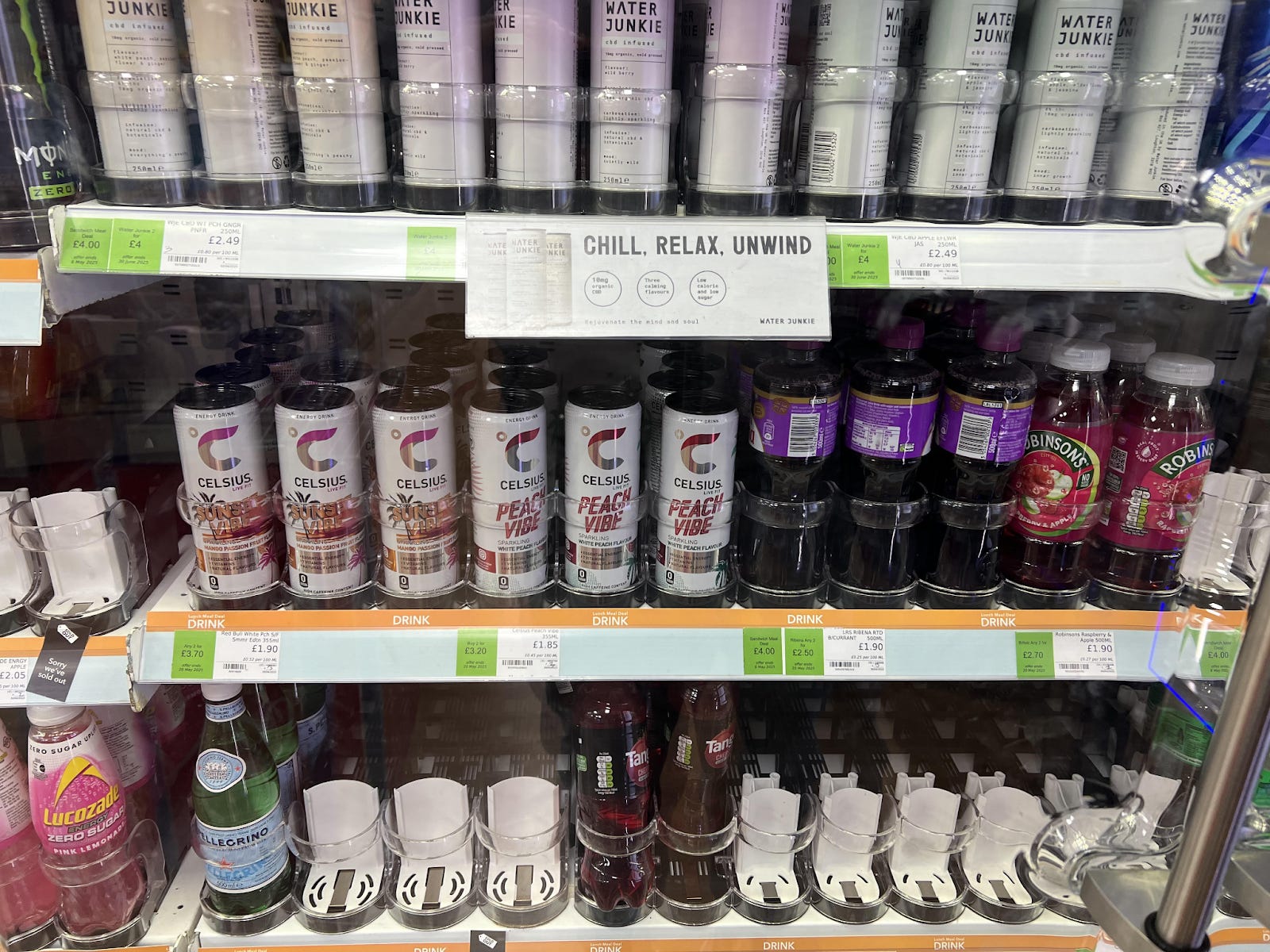
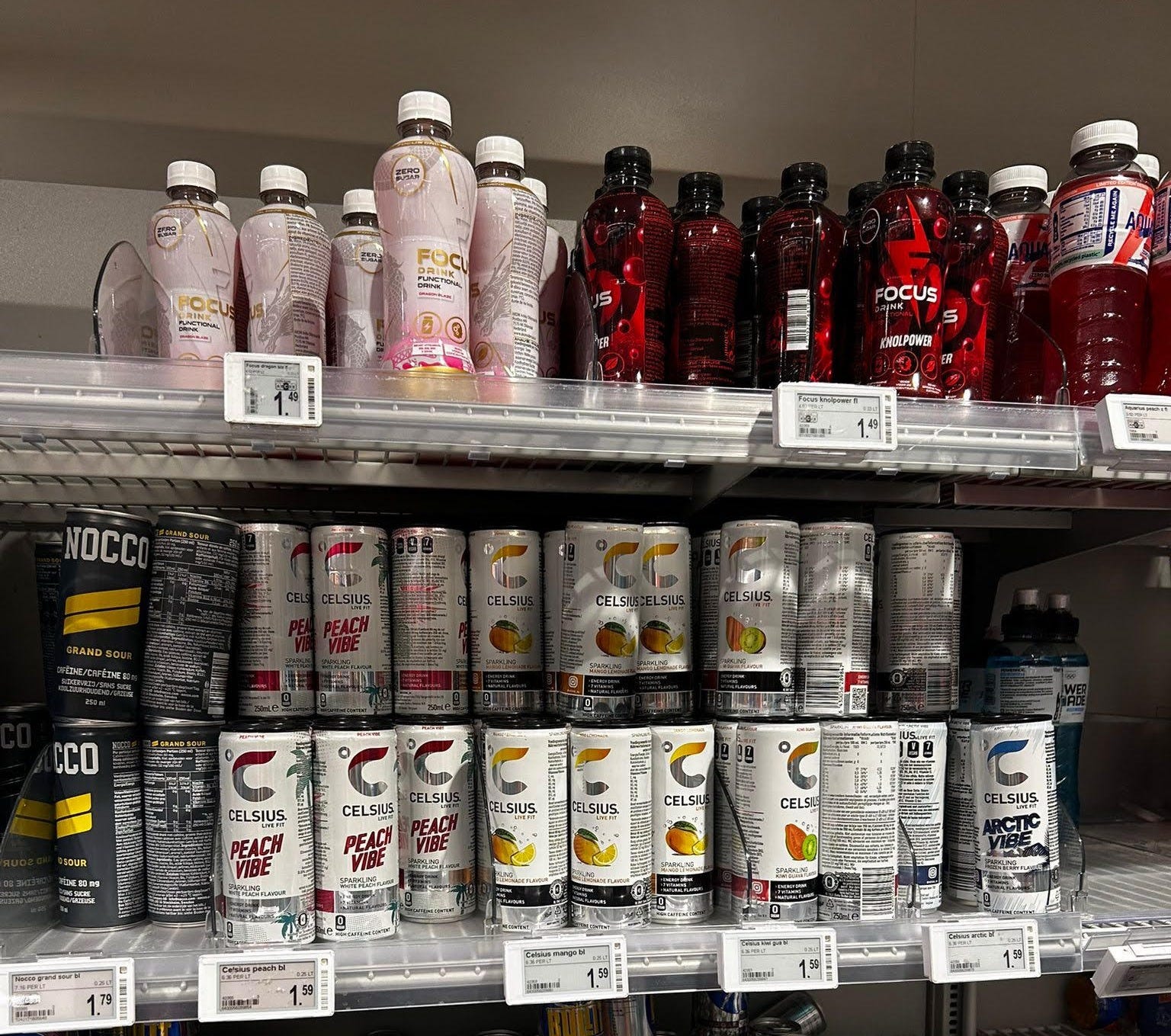
It already has a presence in Finland and Sweden where they have a market share of respectively 13.5% and 6%.
Market and competition
As briefly mentioned in the intro, the energy drink market is extremely competitive and dominated by Red Bull and Monster, having together about ~70% of market share. Red Bull had about €11.2bn in revenues globally (66% United States), while Monster had about $7.5bn in revenues in ‘24 globally ($4.3bn in US). Red Bull is the market leader, while Monster is a close #2 in the US. Monster has a lot of brands and together they add up to a higher market share. Red Bull is private, little to be found than just the market share and some key financial data. Celsius is with 11% market share #3 and then you have a lot of smaller players with a market share below 3-4%. According to former Commercial Director st Monster Energy, he had the following the say:
The energy drink category is booming. The CAGR is strong, and retailers are reallocating space from other categories to expand their energy drink offerings. There are new users entering the category for multiple reasons. Even in our company, where we sell tea, we discuss whether it makes sense to create an organic energy drink offering due to the category's growth trajectory. The CAGR for the next 20 years suggests it will continue to thrive. It's a highly competitive category that demands more space and attention

The size of the energy drink market in the US is estimated around $20-25bn according to various sources. And is expected to grow by a CAGR of ~7% according to Grand View Research1. In dollar sales the US energy drink market grew between 11-12% annually in the last decade. Globally, the size of the energy drinks market varies between $80 to 105bn2 and the market is expected to grow between 7-8% for the next five years and grew by about 7% in the last decade.
Red Bull and Monster
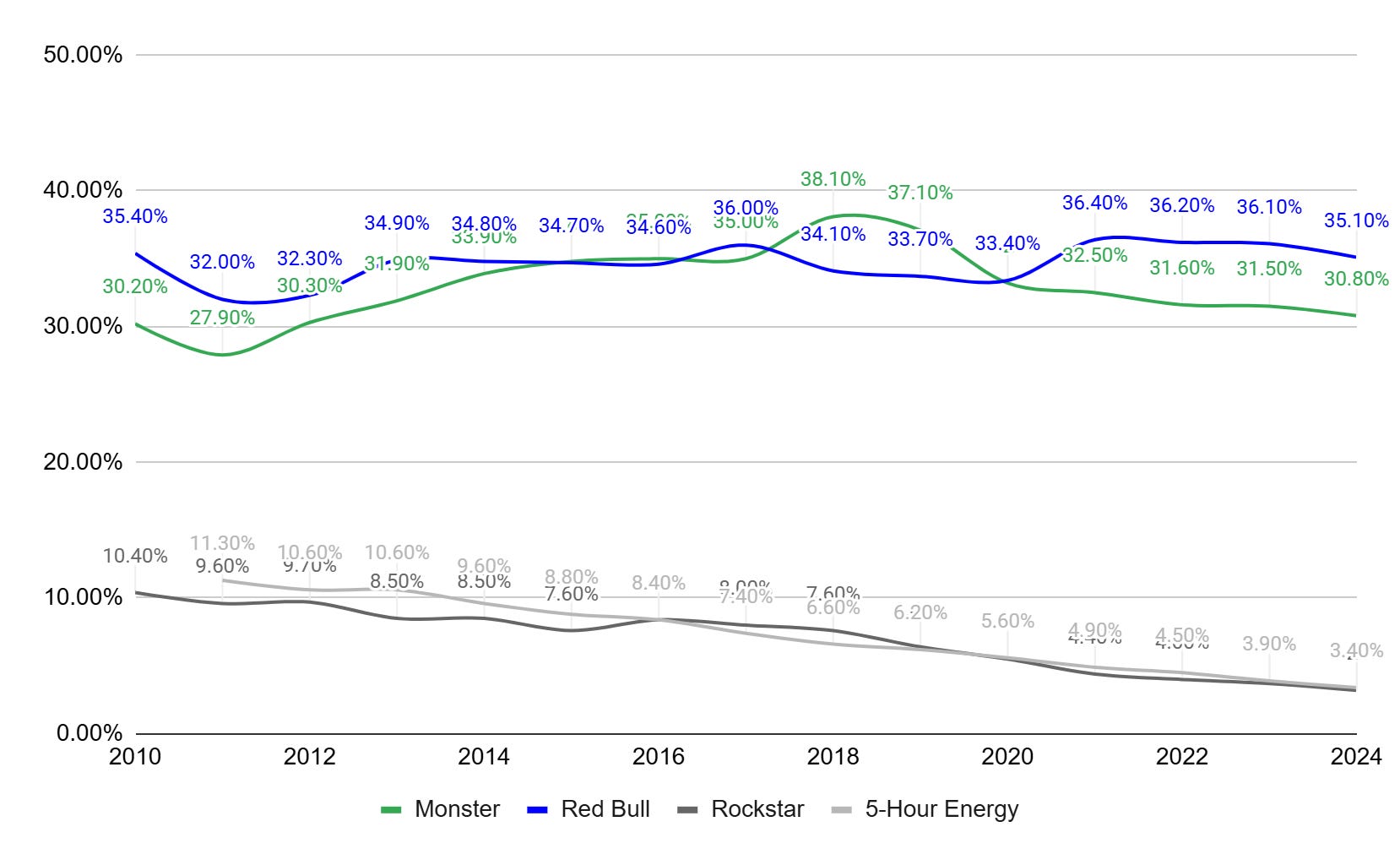
Both brands have been dominating the past 2 decades and since '10 there were 2 contenders. Rockstar and 5-Hour Energy, but their market share has been declining since then, highlighting how competitive the industry is.
Rockstar was founded in ‘01 and in ‘05 Coca Cola became the main distributor for the energy drink brand. There is not much information to be found about the market share before ‘10. Estimated market share was 14% in ‘08. When Coca Cola ditched Rockstar and moved to Monster Energy as main distributor, Rockstar’s market share declined further. In ‘20 PepsiCo acquired Rockstar for $3.85bn and tried to revive the brand, but wasn’t able to turn it around. Currently, Rockstar has a market share of 2.7% in the US.
5 Hour Energy launched in ‘04 and quickly became a massive success by carving out a new energy drink category. But after FDA investigations, deceptive advertising lawsuits, copy cats and fierce competition from Red Bull and Monster, it slowly declined further towards ~3%.
Fast forward, from ‘22 it has been a while that Red Bull and Monster got ‘some’ competition from Celsius (see graph below) and later on Alani Nu. Both Celsius and Alani carved out a niche for themselves, a more healthy / fitness-like drink. After PepsiCo became the main distributor for Celsius, revenues and market share shot up. But Alani Nu saw its growth spur as well since 3Q ‘24. Alani Nu seems to have predominantly female customers, while Celsius, it is 50/50. Both brands have more female customers than Red Bull and especially Monster. While doing my research, I came to the conclusion that Alani Nu would be a more serious threat than Monster because they serve the same customer group. With the deal, Celsius holdings neutralized that risk and together they have about 16% market share. According to management, they noticed that Alani Nu has the same growth potential Celsius had 2 years ago. If Alani pulls it off and has the same growth as Celsius the next 2 years, there would be a possibility the combination of both brands could reach 20% market share or even more.
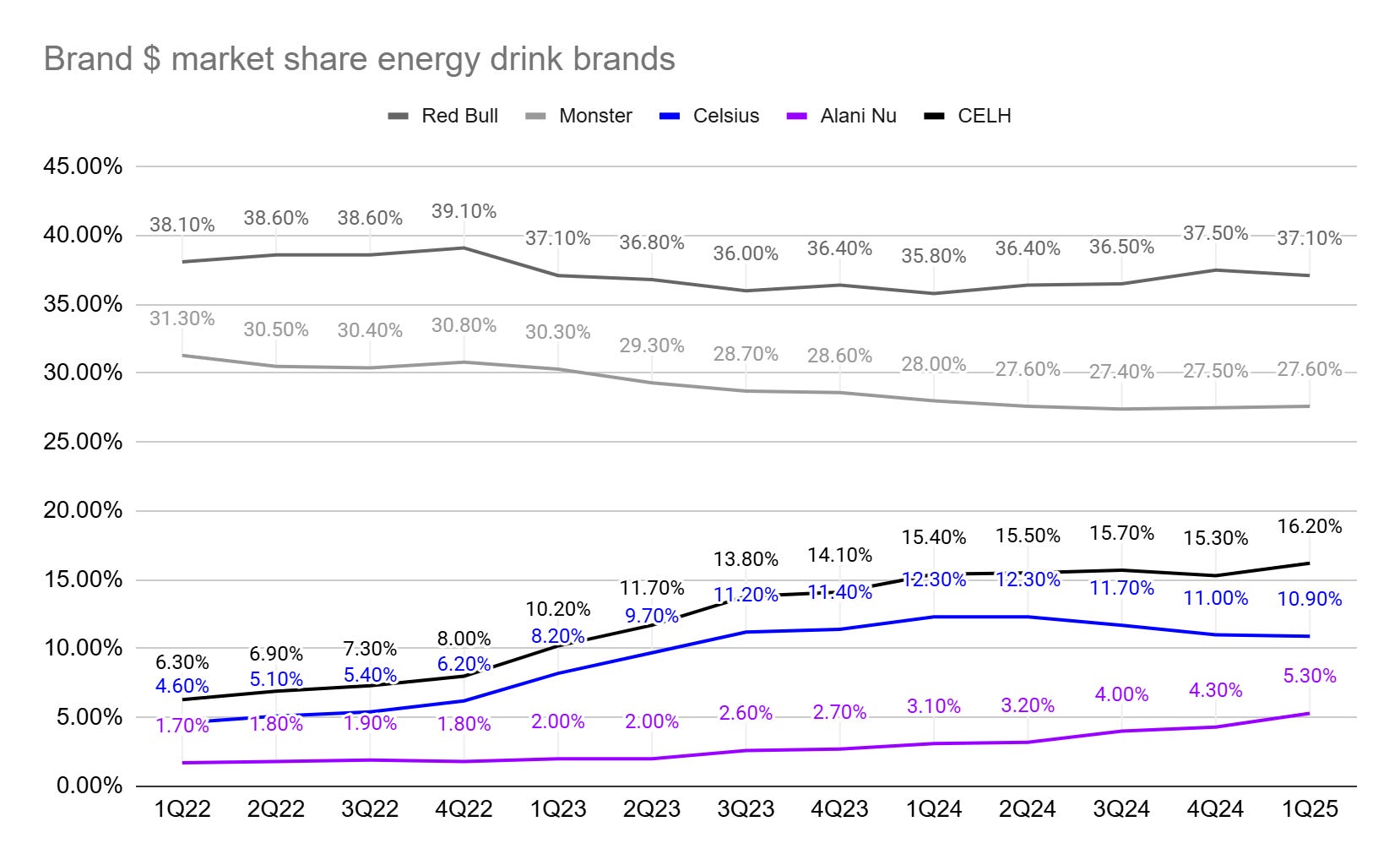
If Celsius just manages to hold on to their market share (which they seem to be able to do) they can grow revenues in line with the market (which is expected to grow +8% the next 5 years). The Alani Nu acquisition should give Celsius Holdings a boost, while international expansion just started.
Currently, Alani Nu is distributed by AB Inbev. Celsius has been distributed by AB Inbev in the past as well. The question you naturally would ask is, will Alani Nu move to PepsiCo as well? This question has been asked many times by analysts and management never gave a clear answer. To me it only makes sense for Alani Nu to move to PepsiCo and I think this will eventually happen.
Management
A lot or if not almost all the credit of the current success of Celsius we should give to John Fieldly. He joined in ‘12 as CFO and became CEO in ‘18. Since then Celsius underwent a massive change and became the energy brand that it is today.
Although he is not the founder, I consider him to have a founder-led mentality. I think what he did is extremely impressive. Having read a lot of interviews of him, my impression is that he is a fighter. He will try new things and is open minded. He uses every opportunity to promote his product.
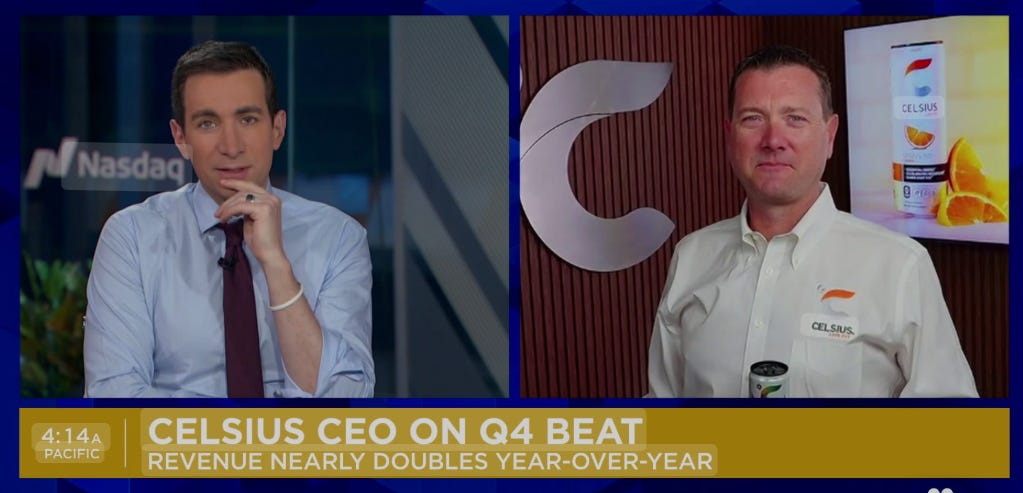
When he is interviewed on CNBC, he is wearing a shirt with a Celsius logo and a can in his hand. He puts his ego aside for the benefit of the company. I mean who does that as the CEO of a company? I love it!
The capital allocation decisions so far have been good. The money they have received from Pepsi, they have used wisely. Firstly by acquiring a co-packer (Big Beverages) in November ‘24 for $75m, and according to the latest numbers, you see the vertical integration reflecting back in the numbers as gross margin improved already slightly in Q1 ‘25. In April ‘25 they acquired an energy drink brand which is following the same growth path as Celsius had and having the same customer profile.
I don’t know how they pulled it off, but it is an extremely smart move. Off course there is execution risk and we will learn if management is able to integrate Alani Nu successfully within the holding. It’s something they haven’t done before, but the track record they have so far, has been good. I am optimistic.
Moat
The distribution is the moat. If you have a strong distribution network (i.e. Coca Cola, Pepsi) it is very hard for new entrants to compete. Especially if you want to grow towards a double digit market share. You have seen how quickly Celsius gained market share when Pepsi took over the distribution. Coca Cola has the best distribution worldwide and PepsiCo is the second best. Coca Cola has a stake in Monster and PepsiCo partnered with Celsius. Both will not have an incentive to cannibalize their own brands.
The Celsius brand is also a moat, although narrow, and Celsius has carved out a niche within the energy drinks market. Female customers are just more inclined to walk with a can of Celsius than a can of Monster. With the acquisition of Alani Nu, they will get more scale and be able to fend off potential new entrants. Although the moat is narrow, it can widen. Once consumers become more familiar with the brand and buying Celsius become part of their daily habits, it is difficult to break that routine. That is something management is working very hard on currently. This is what John Fieldly recently said on a conference in June ‘25:
And that convenience shopper is very transactionally driven. And so you only have about two seconds for someone to make a decision. You're kind of like creatures a habit. So we need to get into their daily lifestyle of daily routine. And once we do that, we know we can drive loyalty.
Financials & valuation
Because this research piece is becoming pretty big, I’ll keep the financials brief but will add a Google sheet to share my assumptions on the valuation so that you can play with the numbers yourself.
Download: Celsius valuation + financials
Below a 5 year history of the P&L statement. Heavy growth in ‘19 to ‘23 followed by just +3% in ‘24. In the last column, I added the pro-forma numbers (GAAP) post the Alani Nu acquisition which was provided by management. If we look at the latest numbers, you notice the difference in FCF and net profit. This has mainly to do with changes in net working capital. I excluded the acquisition of Big Beverages from the FCF because I would consider that a one-off, but if you include that, you have to deduct $75m from the FCF.
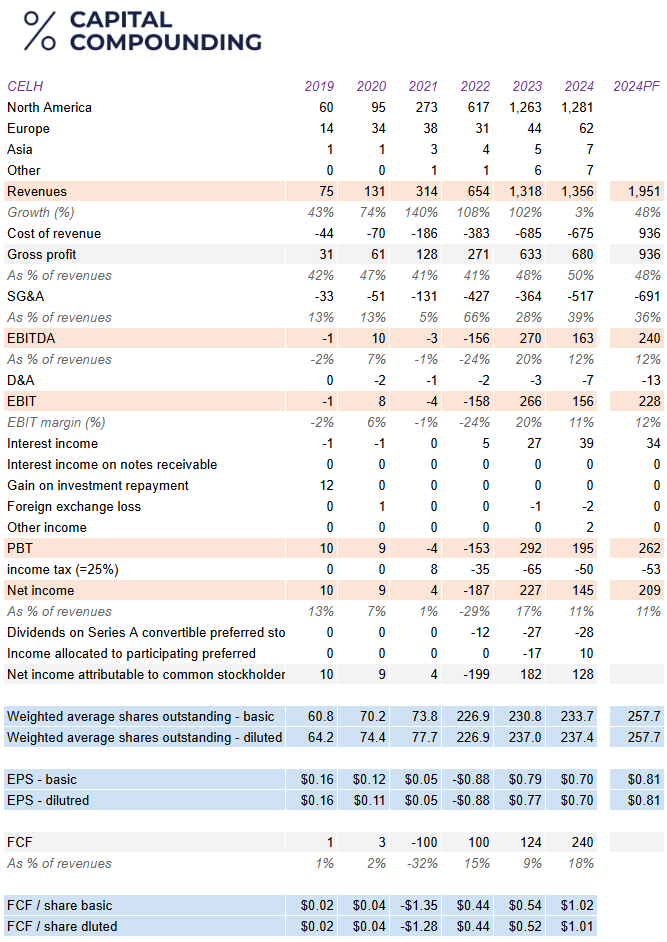
SG&A expense as percentage of revenues went up to 39%. There are some litigation costs ($54m) and some other one offs due the acquisition ($17m). Together this adds up to about ~5% of SG&A.
Celsius has a big cash position on its balance sheet of $890m as per FY24 and that is generating an interest income of $39m. The dividends paid are related to the investment from PepsiCo. Celsius pays until the preferred shares are converted into common shares (which is in ‘28) 5% dividend to PepsiCo.
Financing
Celsius issued a 7yr $900m term loan maturing to finance the acquisition of Alanu Nu. The coupon is set at SOFR + 3.25%, which equates roughly to 7.5%. This can drop by 25bps if net leverage ticks down to 0.75x. So from ‘25 onwards the net interest income on the P&L will go from ~$39m to minus ~$57m (management guidance).
With the new financing, net leverage ticked up towards 1.0x which is reasonable.
Valuation
So for ‘25, on a combined basis, management expects gross margin to be between 47-49% and SG&A between 32-34%. If we use these numbers as a starting point for our forecast, I expect the gross margin to trend up towards 52-53% in the medium term. Celsius already reached in Q1 ‘25 a gross margin of 52.3% due to scale effects from the Big Beverages acquisition. Alani Nu has a lower gross margin (42%) and this will weigh in the short term, but I expect once it is integrated, economies of scale will kick in. As a reference Monster has a gross margin of about ~57% currently. SG&A I expect to trend down as well in the medium term towards at least 29% in the medium term. Again as a reference point, Monster SG&A expenses as percentage of revenues are ~26%. Over time I expect management to pay down some of the debt and the cash that builds up from the FCF generation should result in overall lower net interest expenses.
Revenues growth I keep at +12% for the coming five years. The market by itself is expected to grow to about +8% a year and expect that Alani Nu will continue to grow in the coming years. Celsius I expect to keep their market share of about 11-12% they currently have. Of course the revenues growth is the hardest part to predict and there could be upside surprises on 1) international expansion and 2) prolonged high growth from Alani Nu.
Assuming 12% growth for the coming 5yrs and a FCF margin of 20%, I expect at the current share price an IRR of about 11-12% when assuming a multiple of 25x.
Conclusion
There is a lot to like about Celsius Holdings. The last couple of years have been messy as the company first experienced explosive growth following the partnership PepsiCo, but then in ‘24 growth stalled. Nevertheless, in a competitive market, where it is difficult to enter, Celsius managed to pull this off and kept its market share in the last 12 months. Following the acquisition of Alani Nu it will increase its market share towards at least 16% and cemented its position as a #3 player in the US. I see business which is slowly growing its moat further.
It seems that Alani Nu’s explosive growth hasn’t ended and Celsius has the right toolkit (i.e. management experience, stronger distribution) to extend this growth path. Both on the margins and growth there is still a decent amount of headroom within both Celsius and Alani Nu. I would not be surprised if the distribution of Alani Nu will be moved to PepsiCo. Internationally, there seems to be less competition in the energy drinks market than in the US. Especially in Europe. If Celsius executes well, there is a long growth path left for them.
The valuation has run up a bit and the entry point currently is less attractive than it was 3 to 4 months ago. The forward P/E is about ~45x and that makes that will give you less margin for error. Still returns are between 11% to 12% according to our calculations.
Although the acquisition of Alani Nu is a game changer, there is still execution risk and we have to closely monitor the integration within Celsius Holdings.
Disclaimer
The information in this article is provided for informational and educational purposes only. The information is not intended to be and does not constitute financial advice or any other advice, is general in nature, and is not specific to you. Before using this article’s information to make an investment decision, you should seek the advice of a qualified and registered securities professional and undertake your own due diligence. None of the information in this article is intended as investment advice, as an offer or solicitation of an offer to buy or sell, or as a recommendation, endorsement, or sponsorship of any security, company, or fund. The author is not responsible for any investment decision made by you. You are responsible for your own investment research and investment decisions.
https://www.grandviewresearch.com/press-release/us-energy-drinks-market-analysis#:~:text=U.S.%20Energy%20Drinks%20Market%20Size%20To%20Reach%20$37.83%20Billion%20By%202030
https://www.globenewswire.com/news-release/2024/11/28/2988864/0/en/Global-Energy-Drinks-Market-to-Surge-Significantly-at-a-CAGR-of-8-by-2030-DelveInsight.html
Indeed a great post again! I believe Celsius has significant untapped potential. There are opportunities to expand into new consumption occasions through alternative formats, as well as to explore adjacent categories—similar to how Monster has diversified into iced tea. Additionally, multipack offerings at varied price points could help unlock growth across different channels.
Once again great post!